
User Guide


175
ADOBE INCOPY CS2
User Guide
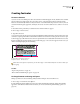
3 Click the Layout tab, and select options that control the look of the footnote section on the page. (See “Footnote
layout options” on page 175.)
4 Click OK.
Footnote numbering and formatting options
The following options appear in the Numbering and Formatting section of the Footnote Options dialog box:
Numbering Style Choose the numbering style for footnote reference numbers.
Start At Specify the number used for the first footnote in the story. Each story in a document begins with the same
Start At number.
Restart Numbering Every If you want numbering to restart within the document, select this options and choose
Page, Spread, or Section to determine when footnote numbering is restarted. Some numbering styles, such as
asterisks (*), work best when reset every page.
Show Prefix/Suffix In Select this option to show prefixes or suffixes in the footnote reference, the footnote text, or
both. Prefixes appear before the number (such as [1) and suffixes appear after the number (such as 1]). This option
is especially useful for placing footnotes within characters, such as [1]. Type a character or characters or select an
option for Prefix, Suffix, or both.
If you think the footnote reference number is too close to the preceding text, adding one of the space characters as a
prefix might improve the appearance. You can also apply a character style to the reference number.
Position This option determines the appearance of the footnote reference number, which is superscript by default.
If you prefer to format the number using a character style (such as a character style that includes OpenType super-
script settings), choose Apply Normal and specify the character style.
Character Style You may want to choose a character style to format the footnote reference number. For example,
instead of using superscript, you might want to use a character style at a normal position with an elevated baseline.
The menu displays the character styles available in the Character Styles palette.
Paragraph Style You may want to choose a paragraph style that formats the footnote text for all footnotes in the
story. The menu displays the paragraph styles available in the Paragraph Styles palette. By default, the [Basic
Paragraph] style is used. Note that the [Basic Paragraph] style may not have the same appearance as the default font
settings for the document.
Separator The separator determines the white space that appears between the footnote number and the start of the
footnote text. To change the separator, first select or delete the existing separator, and then choose a new separator.
You can include multiple characters. To insert white space characters, use the appropriate metacharacter, such as ^m
for em space. For a list of metacharacters, see “Special characters for Find/Change” on page 159.
Footnote layout options
The following options appear in the Layout section of the Footnote Options dialog box:
Minimum Space Before First Footnote This option determines the minimum amount of space between the
bottom of the column and the first footnote line. You cannot use a negative value. Any Space Before setting in the
footnote paragraph is ignored.
Space Between Footnotes This option determines thedistancebetween thelastparagraph of onefootnoteand the
first paragraph of the next footnote in a column. You cannot use a negative value. The Space Before/Space After
values in a footnote’s paragraph apply only if the footnote includes multiple paragraphs.