
Specifications



ST72104Gx, ST72215Gx, ST72216Gx, ST72254Gx
49/141
16-BIT TIMER (Cont’d)
Notes:
1. After a processor write cycle to the OCiHR reg-
ister, the output compare function is inhibited
until the OCiLR register is also written.
2. If the OCiE bit is not set, the OCMPi pin is a
general I/O port and the OLVLi bit will not
appear when a match is found but an interrupt
could be generated if the OCIE bit is set.
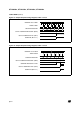
3. When the timer clock is f
CPU
/2, OCFi and
OCMPi are set while the counter value equals
the OCiR register value (see Figure 8). This
behavior is the same in OPM or PWM mode.
When the timer clock is f
CPU
/4, f
CPU
/8 or in
external clock mode, OCFi and OCMPi are set
while the counter value equals the OCiR regis
-
ter value plus 1 (see Figure 9).
4. The output compare functions can be used both
for generating external events on the OCMPi
pins even if the input capture mode is also
used.
5. The value in the 16-bit OCiR register and the
OLVi bit should be changed after each suc
-
cessful comparison in order to control an output
waveform or establish a new elapsed timeout.
Forced Compare Output capability
When the FOLVi bit is set by software, the OLVLi
bit is copied to the OCMPi pin. The OLVi bit has to
be toggled in order to toggle the OCMPi pin when
it is enabled (OCiE bit
= 1). The OCFi bit is then
not set by hardware, and thus no interrupt request
is generated.
FOLVLi bits have no effect in either One-Pulse
mode or PWM mode.
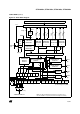
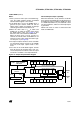
Figure 32. Output Compare Block Diagram
OUTPUT COMPARE
16-bit
CIRCUIT
OC1R Register
16 BIT FREE RUNNING
COUNTER
OC1E CC0CC1
OC2E
OLVL1OLVL2OCIE
(Control Register 1) CR1
(Control Register 2) CR2
000OCF2OCF1
(Status Register) SR
16-bit
16-bit
OCMP1
OCMP2
Latch
1
Latch
2
OC2R Register
Pin
Pin
FOLV2
FOLV1