
Troubleshooting guide



17
www.bendix.com 1-800-AIR-BRAKE (1-800-247-2725)
Actuators
Actuators
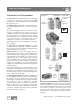
Actuators convert the air pressure being applied into a
mechanical push-rod force acting on the foundation
brakes. Air enters the actuator and pressurizes a
chamber containing a rubber diaphragm. The air pushes
against the diaphragm, pushing against the return spring
and moving the push-plate (and push-rod) forward.
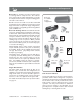
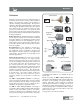
Some different types of actuators used in air brake
systems are: brake chambers, rotochambers (with
longer push-rod stroke travel), spring brake actuators
(for rear brake axles) and safety actuators (with internal
locking mechanisms).
Brake chambers are available in many sizes, providing
a wide range of output forces and strokes. Different
size brake chambers are identified by numbers which
specify the effective area of the diaphragm: a "type 30"
brake chamber has 30 square inches of effective area.
Some brake chambers with extended push-rod stroke
travel are available.
Rotochambers are also available in several sizes,
providing a wide range of output forces. The rolling
type diaphragm used in rotochambers provides long
life and gives a constant output force throughout the
entire stroke. Rotochambers are frequently used in
industrial applications.
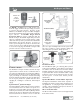
Spring brake actuators are composed of separate
air and mechanical actuators in a single housing.
Mounted at the wheel of the axle it serves, it functions
as a service, parking and emergency brake. Connected
to the service brake valve, the air applied portion of
the actuator functions as the service brake. The
mechanical portion of the actuator contains a powerful
spring which is compressed by adding air pressure or
released by removing air pressure. The spring brake
therefore contains two actuators which use air pressure
in opposite ways. The service actuator requires air
pressure to apply the brakes, while the park or
emergency actuator uses air pressure to release the
brakes.
The SB-1
™
spring brake actuator is a pull type,
remote-mounted air cylinder that is used as a parking
brake. Pressurized air in the chamber compresses the
springs when the brake is released. When the air is
exhausted, the spring force applies the brake.
The SD-3
™
roto safety actuator is basically a
rotochamber with mechanical roller locking mechanism
similar to that of the DD3
®
actuator. The SD-3
™
actuator is generally used on off-highway vehicles, and
is piped in various ways to provide service, emergency,
Brake Chamber
Rotochamber
SB-1
™
Spring Brake
SD-3
™
Roto
Safety Actuator
Diaphragms
Spring Brake
Chamber
Brake Chamber
Return
Springs
Spring Brake Chamber
Parking
Spring
Yoke
and parking brake functions. It is available in type 36
and 50 sizes.
Rarely used today, the DD3
®
safety actuator (not
shown) was a dual diaphragm brake actuator with three
functions; service braking, emergency braking and
parking. The DD3
®
actuator featured a mechanical
roller locking mechanism for parking and was used
extensively on transit and innercity buses. Because of
its unique locking roller mechanism, the DD3
®
actuator
required the use of special control valves such as the
TR-2
™
inversion valve.
See page 54 for more about actuators.