
Troubleshooting guide


19
www.bendix.com 1-800-AIR-BRAKE (1-800-247-2725)
Foundation Brakes
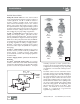
The foundation brake is the actual braking mechanism
located at each end of the axle. It generally consists of
an air or spring brake chamber (with slack adjuster for
S-Cam), and a mechanical brake mechanism including
the friction material.
S-Cam Brakes
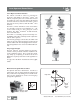
In a cam type foundation brake the pneumatic system
is linked to the foundation brakes by the slack adjuster.
The arm of the slack adjuster is fastened to the push
rod of the chamber with a yoke. The spline of the
slack adjuster is installed on the brake cam shaft. The
slack adjuster is a lever, converting linear force of the
chamber push rod into a torsional or twisting force
needed to apply the brakes.
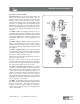
When torque is applied to the cam shaft, the "S" shaped
cam spreads the brake shoes, forcing the brake lining
into contact with the brake drum stopping the vehicle.
Cam brakes are offered in various diameters to meet
vehicle braking requirements, with the most commonly
encountered being 16 1/2". The cam brake has a
"leading-trailing" shoe design with fixed anchor points
for each shoe, opposite the cam end of the shoe.
S-Cam Brake Block and Lining
When S-Cam brakes are applied, the friction material
contacts the brake drum, producing heat energy. For
optimal performance the heat that is generated must
dissipate rapidly to prevent damage to the friction
material. Therefore the friction material used in the
brake must have the capability of withstanding the heat
until dissipated through the drum. It takes the right
combination of ingredients to formulate the friction
material that provides all the desirable characteristics,
including long life.
All friction material is identified by a stencil on its edge.
This identification code consists of the name of the
manufacturer, the formula identification and the friction
class. The friction class is indicated by two letters.
The first letter represents the normal coefficient of
friction, and the second represents the hot coefficient
of friction. The numerical range is shown on page 20.
Friction material selection is dependent upon how the
driver uses the brakes, the terrain, vehicle load, etc.
The various formulations of material are designed to
meet the needs of these conditions. For example, a
vehicle performing heavy duty operations on rugged
terrain may benefit by using a "premium" material
designed for high heat situations instead of a "standard"
material designed for lighter duty operations.
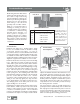
Foundation Brakes
Axle
Brake Chamber
Brake
Drum
Shoe
CAM
Slack Adjuster
S-CAM BRAKE
Spider
Friction Material
Brake
Chamber
Brake Pad Friction
Material
Rotor
AIR DISC BRAKE