
Troubleshooting guide


37
www.bendix.com 1-800-AIR-BRAKE (1-800-247-2725)
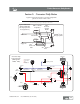
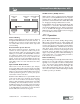
Driver
Right Steer
Axle
Left Steer
Axle
Right Additional
Axle
Left Additional
Axle
Right Drive
Axle
Left Drive
Axle
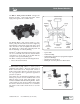
Normal Braking
During normal braking, air brake pressure is delivered
through the ABS PMV and into the brake chamber. If
the ECU does not detect excessive wheel slip, it will
not activate ABS control, and the vehicle stops with
normal braking.
Retarder Brake System Control
On surfaces with low traction, application of the
retarder can lead to high levels of wheel slip at the
drive axle wheels, which can adversely affect vehicle
stability. To avoid this, some Bendix ECU controllers
are designed to switch off the retarder as soon as a
lock-up is detected at one (or more) of the drive axle
wheels. In these cases, when the ECU is placed in the
ABS off-road mode, it will switch off the retarder only
when ABS is active on a steer axle wheel and a drive
axle wheel.
Optional ABS Off-Road Mode
When used on some off-road surfaces, (for example,
loose gravel), ABS provides superior vehicle steerability
and stability, however there is the potential for stopping
distances to be longer than without ABS. This is because
locked-up wheels on gravel, etc. tend to plow up the
road surface in front of the tires.
Bendix Premium ECUs have an optional ABS off-road
control mode that more effectively accommodates
these soft road conditions and shortens stopping
distances while maintaining optimal vehicle steerability
and stability. Care must be taken, however, not to use
the ABS off-road mode on normal, paved road surfaces
(since vehicle stability and steerability may be reduced),
so the ABS Indicator Lamp flashes to show the driver
that the ABS off-road mode is being used.
All-Wheel Drive (AWD) Vehicles
AWD vehicles with an engaged interaxle differential
(steer axle to rear axle)/AWD transfer case may have
negative effects on ABS performance. Optimum ABS
performance is achieved when the lockable differentials
are disengaged, allowing individual wheel control.
Premium ECUs can be programmed specifically for this
configuration to control the differential lock/unlock
solenoid in the AWD transfer case. When programmed
to do so, the ECU will disengage the locked interaxle/
AWD transfer case during an ABS event and reengage
it once the ABS event has ended.
ATC Operation
ATC Functional Overview
Just as ABS improves vehicle stability during braking,
ABS systems with ATC improve vehicle stability and
traction during vehicle acceleration. The ATC function
uses the same wheel speed information and modulator
control as the ABS function. The ECU detects excessive
drive wheel speed, compares the speed of the front,
non-driven wheels, and reacts to help bring the wheel
spin under control. The ECU can be configured to use
engine torque limiting and/or differential braking to
control wheel spin. For optimal ATC performance,
both methods are recommended.
Differential Braking
Differential braking is automatically activated when drive
wheel(s) on one side of the vehicle are spinning, which
typically occur on asphalt road surfaces with patches
of ice. The traction system will then lightly apply the
brake to the drive wheel(s) that are spinning. The
vehicle differential will then drive the wheels on the
other side of the vehicle. Differential braking is available
at vehicle speeds up to 25 MPH.
Truck and Tractor ABS Operation; ATC