
Troubleshooting guide


47
www.bendix.com 1-800-AIR-BRAKE (1-800-247-2725)
Section 8: The Fundamentals of Air Braking
Friction
Air brakes are mechanical devices that use friction to slow
or stop vehicles. An understanding of the laws of friction
will be a useful introduction to the concepts behind brake
design and maintenance.
Coefficient of Friction
Friction is the resistance to relative motion between any
two bodies in contact, and it varies not only with different
materials, but also with the condition of the materials.
The amount of friction developed by any two bodies in
contact is referred as their coefficient of friction, which is
the amount of force required to move the one body while
it remains in contact with the other.
Heat is always present where friction is being developed.
For example, when a bearing is not properly lubricated,
the lack of lubrication causes a rise in the coefficient of
friction with a resultant rise in the heat produced. The
heat may reach a point where the bearing fails.
Energy of Motion Becomes Heat Energy
Since friction is the resistance to relative motion between
two bodies in contact and since friction results in heat, a
more complete definition of a brake would be that it is a
mechanical device for retarding the motion of a vehicle by
means of friction, thereby changing the energy of motion
into heat energy.
Stated another way, when the speed of a vehicle is reduced
by applying the brakes, the energy of motion is actually
changed into heat energy, and the brakes must dissipate
or absorb the heat developed.
Braking Force
It is difficult to appreciate the tremendous forces involved
in stopping a modern commercial vehicle, particularly from
the higher speeds.
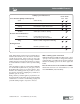
A simple method of explaining this is to make a comparison
between the horsepower required to accelerate a vehicle
and the horsepower required to stop it. A truck with an
engine capable of developing 100 horsepower will require
about one minute to accelerate to 60 miles per hour. The
same vehicle should be capable of easily stopping from 60
miles per hour in not more than six seconds. Ignoring the
unknown quantities, such as rolling friction and wind
resistance which play a part in all stops, the brakes must
develop the same energy in six seconds as the engine
develops in 60 seconds; in other words, the brakes do the
same amount of work as the engine in one-tenth the time
and must develop approximately 1,000 horsepower during
the stop.
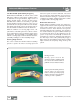
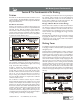
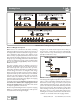
The coefficient of friction is expressed by the relation of
the amount of force divided by the weight of the moving
body. Let's look at three examples:
In Figure 1, example (a), if the moving body weighs 100
pounds, and a force of 60 pounds is required to keep it
moving while it remains in contact with another body,
then the coefficient of friction between the two bodies is
60% or 0.6. For (b), if 50 pounds force is necessary to
keep it moving, the coefficient of friction is 50% or 0.5.
For (c), if only 35 pounds force is required, the coefficient
of friction is 35% or 0.35.
The coefficient of friction between any two surfaces
changes with any variation in the condition of one or both
surfaces. As an example, the introduction of oil or grease
between two dry, flat metal surfaces will greatly reduce
the friction between them, which demonstrates that the
condition of these surfaces plays a great part in the actual
friction they develop. This possible variation in the
coefficient of friction is always present when any factor
contributing to the frictional value of any material is subject
to change either permanently or temporarily.
FIGURE 2 - Forces Involved in Braking
(a)
(b)
(c)
FIGURE 1 - Coefficient of Friction
Air Brake System Fundamentals