
Troubleshooting guide

50
www.bendix.com 1-800-AIR-BRAKE (1-800-247-2725)
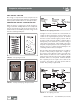
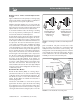
Deceleration Rate 2 miles per Hour per Second
Deceleration Rate 10 ft. per Second per Second
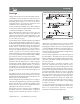
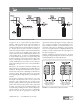
Another form of lever found in drum-brake forms of
braking systems is the brake shoe. This is one of the
simpler forms because it is easily recognized as a beam,
fulcrumed at one end on the hinge pin, which forces the
brake lining against the drum when the brake cam force is
applied to the other end.
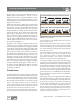
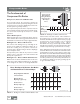
Perhaps the least easily recognized lever in a drum brake
system is the relation of the brake drum diameter to the
tire diameter. In order to understand this fully it must be
remembered that although the brakes stop the brake
drums and wheels, it is always the tires and road surface
that stop the vehicle. This is clearly demonstrated when
quick stops are attempted on wet or icy roads. Under
these conditions the brake equipment may still be as
efficient as ever in stopping the wheels, but its ability to
stop the vehicle quickly diminishes because there is not
sufficient friction between the tire and road to develop
the necessary retarding force.
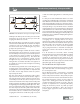
Returning to the principles of leverage involved in the
relation of the tire and brake drum size, the retarding
force developed by the brake shoes acting against the drum
is working on an effective lever length of the brake drum
radius. Counteracting this is the retarding force developed
between the tire and the road, working on an effective
lever length of the rolling radius of the tire. Since it is not
practical to have brake drums as large as the tires, the
principles of leverage require development of a greater
retarding force between the brake shoes and the drums
than between the tire and the road. Also, since a rubber
tire on a smooth, dry road surface has a higher coefficient
of friction than brake lining against a brake drum, it is
necessary to develop additional retarding force between
the brake shoes and brake drum in order to overcome
the difference in friction.
Deceleration
In discussing brakes, the term deceleration is often used.
This term expresses the actual rate at which vehicle speed
is reduced and usually denotes the speed being reduced
each second, in terms of miles per hour or feet per second.
As an example as shown in Figure 6 - if a vehicle is moving
at the rate of 20 miles per hour, and one second later its
speed is only 18 miles per hour, the vehicle has reduced
its speed by two miles per hour during one second, its
deceleration rate is two miles per hour per second.
In the same way, if a vehicle is moving at a rate of 30 feet
per second, and one second later its speed is only 20 feet
per second, then it is decelerating at the rate of ten feet
per second per second.
Therefore, the change in the rate of speed of a vehicle
during a slowdown or stop is expressed by first stating
the rate of speed being lost, such as miles per hour or feet
per second, and then by stating the time required for this
rate of speed to be lost.
Thus, in examining the expression covering a deceleration
rate of say, "ten feet per second per second," the first
part – "ten feet per second" – is the rate of speed being
lost, and the second part – "per second" – is the time in
which the loss of ten feet per second takes place.
If a vehicle is moving at a known rate, and is decelerating
at a known rate, the stopping time will be the initial speed
divided by the deceleration rate, provided both the rate
of speed and the deceleration rate are expressed on the
same basis. As an example – if a vehicle is moving at the
rate of 30 feet per second and is decelerating at the rate
of ten feet per second, the stopping time will be the initial
speed of 30 feet per second divided by the deceleration
rate of ten feet per second per second, or a stopping time
of three seconds.
This perhaps can be more easily understood if explained
in the following manner; if a vehicle is moving at the rate
of 30 feet per second and begins to decelerate at the rate
of ten feet per second per second, at the end of the first
second it will be traveling 20 feet per second; at the end
of the second second, it will be traveling ten feet per
second, and at the end of the third second, it will be
stopped. Thus, by losing speed at the rate of ten feet per
second per second, it would lose its initial speed of 30
feet per second in three seconds.
FIGURE 6 - Deceleration
Leverage (continued), Deceleration