
Troubleshooting guide

51
www.bendix.com 1-800-AIR-BRAKE (1-800-247-2725)
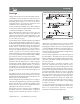
Similarly, if the initial speed is 20 miles per hour and the
deceleration rate is two miles per hour per second, the
stopping time will be ten seconds.
One important thing to remember in respect to stopping
vehicles is the fact that while the deceleration rate may be
constant for each second during the stop, the distance
the vehicle travels each second during the stop varies
greatly as the speed decreases.
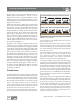
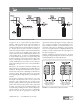
This is illustrated in Figure 7 which also shows a vehicle
decelerating at the rate of ten feet per second per second
from an initial speed of 30 feet per second, but the positions
of the vehicles are shown in relation to the distance
traveled each second during the stop. This shows that
although the rate of deceleration remains constant
throughout the stop, the vehicle actually travels 25 feet
during the first second after the brakes were applied, 15
feet during the second second, and only five feet during
the third second.
The distance being traveled each second during the stop
is always greater at the beginning of the stop. To keep
stopping distance as short as possible, it is important that
the brakes become fully effective when the pedal is
depressed by the driver.
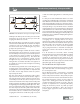
Any time lost between the instant the brake pedal is
depressed and the instant actual deceleration begins is
important because the vehicle continues to travel at close
to its initial speed. In this case, the loss of only one second
between the instant the driver depresses the brake pedal
and the point where the brakes are really applied will result
in lengthening the actual stopping distance by 30 feet. Thus,
if four seconds instead of three elapse between the instant
the driver depresses the brake pedal and the instant the
vehicle stops, the actual stopping distance will be increased
from 45 feet to 75 feet. In other words, by reducing the
stopping time under these conditions by only one second
or 25%, the actual stopping distance is reduced by 30 feet
or 40%.
It is this part of brake fundamentals which is not often
considered in evaluating brake performance, particularly
when different forms of brakes are involved. A common
method of testing brakes is by the use of a decelerometer–
a device that determines the maximum rate of deceleration
developed during a stop and which shows a calculated
stopping distance from a speed of 20 miles per hour based
on the maximum rate of deceleration developed during a
stop. Such instruments do not, however, make allowances
for lost time before the braking system develops full power
and therefore are not suitable for analyzing time lag factors
in brake performance.
The true performance of any type of brake system in terms
of stopping time or stopping distance can only be
determined by actually measuring the time and distance
the vehicle travels from the instant the driver depresses
the brake pedal to the point where the vehicle actually
stops. Such tests can, of course, be made comparative
only by using instruments to determine accurately the
speed of the vehicle at the instant the brake pedal is
depressed.
In so far as brakes are concerned, a driver is mainly
interested in the amount of time and the distance required
to bring the vehicle safely to a stop under emergency
conditions as measured from the instant he or she
depresses the brake pedal. Any lag in the time between
the instant the brake pedal is depressed, and the instant
the brakes apply, affects stopping distance.
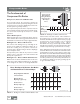
The Fundamentals of Compressed Air
Compressed air is air which has been forced into a smaller
space than that which it would ordinarily occupy in its
free or atmospheric state.
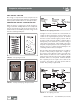
Free air which we breathe – or atmosphere – is normally
always under pressure because of the weight of the air
above it. This pressure amounts to 14.7 pounds per square
inch at sea level, and it decreases as the altitude increases.
The normal atmospheric pressure of 14.7 pounds per
square inch is usually ignored and the atmosphere is
considered as being free air under no pressure. Thus, the
pressure of compressed air is commonly indicated by
stating the amount the pressure, in pounds per square
inch, is above the atmosphere. This is the reason air
pressure gauges register zero when connected only to
atmosphere.
FIGURE 7 - Deceleration at 10 feet per second per second
Deceleration (continued), Compressed Air