
Troubleshooting guide

53
www.bendix.com 1-800-AIR-BRAKE (1-800-247-2725)
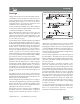
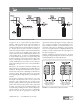
In Figure 12, we see a piston with an air-tight chamber
behind it. When compressed air enters the chamber it
will cause the piston to move until it encounters a
resistance equal to the force developed by the compressed
air. Because the air pressure is based on pounds per
square inch, it follows that the compressed air will develop
a force in pounds on the movable object equal to the
product of the air pressure multiplied by the effective area
of the movable object. If a piston or a flexible diaphragm
in a brake chamber has an area of ten square inches and
air at five pounds per square inch pressure is acting on the
piston or diaphragm, the developed force will be 50
pounds. Similarly, if air at a pressure of ten pounds per
square inch is acting upon it, a force of 100 pounds will be
developed.
One point to be remembered is that the quantity of air
acting on the piston or diaphragm does not affect the force
developed. The only factors involved are the air pressure
and the area of the piston or diaphragm on which the air
pressure is acting. This means that we can control the
force applied by the braking system by controlling the air
pressure.
The pressure exerted by compressed air is not only
developed in all directions, but it is also equal in all
directions. The compressed air in a reservoir exerts
pressure equally in all directions against the entire inside
surface of the reservoir (the pressure of the compressed
air being overcome by the mechanical strength of the
reservoir walls). Similarly, the force developed by the air
pressure acting on one side of a piston or a diaphragm
may be overcome by an opposing force acting on the
opposite side, and the opposing force may be compressed
air or it may be mechanical. If the opposing forces are
equal, a balanced condition is reached and there is no
movement of the piston or diaphragm. If the opposing
forces are not equal, the piston or diaphragm will move, if
possible, to assume a position where the opposing forces
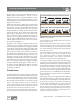
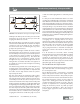
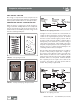
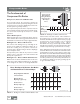
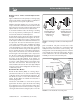
are equal. See Figure 13.
This law of balanced pressures and forces is the basic
principle governing the design and operation of the control
and actuating devices in an air brake system.
FIGURE 12 - Fundamentals of Compressed Air
FIGURE 13 - Fundamentals of Compressed Air
Properties of Compressed Air (continued)
Where Supply B
pressure is greater than
Supply A pressure
Where Supply A
pressure is the same as
Supply B pressure