
Troubleshooting guide

55
www.bendix.com 1-800-AIR-BRAKE (1-800-247-2725)
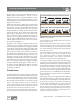
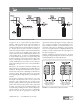
FIGURE 16 - Braking Forces-Effect of Slack Adjuster Arm
Length
Torque On Brake
Camshaft 4000 Inch
Pounds With Slack
Adjuster Arm 4
Inches Long.
Torque On Brake
Camshaft 6000 Inch
Pounds With Slack
Adjuster Arm 6
Inches Long.
S-Cam and Air Disc Brakes
Braking Forces - Effect of Slack Adjuster Arm
Length
Figure 16 illustrates how the principles of leverage apply
when a brake chamber and slack adjuster combination is
being selected to meet specific requirements.
With the same brake chamber force of 1,000 pounds, the
torque on the brake camshaft can be increased from 4,000
inch pounds to 6,000 inch pounds merely by using a slack
adjuster with a 6" arm instead of one with a 4" arm.
In an S-Cam foundation brake, the full range of braking
forces for any vehicle is provided by the use of different
sizes of brake chambers and slack adjusters.
A term which is used to express the relation of the brake
chamber size and slack adjuster arm length is “AL” factor.
The “AL” factor differs from torque or turning moment
in that only the variable factors which determine the force
are expressed. The reason for this is that an air pressure
of 60 pounds is generally used in calculating air braking
forces and therefore, is considered constant. The length
of the slack adjuster lever arm and the size or effective
area of the brake chamber acting on the slack adjuster are
the two variables altered to meet braking requirements.
The product of the effective area of the brake chamber
and the length of the slack adjuster arm is expressed as
the “AL” factor, which, when multiplied by the 60 pounds
air pressure used in making brake calculations, determines
the torque on the brake camshaft. As an example: If a
brake chamber having an effective area of 16 square inches
is acting on a slack adjuster having an arm length of five
inches, the “AL” factor is 80. The actual torque on the
brake camshaft is therefore the “AL” factor (80) multiplied
by the air pressure used in making brake calculations (60),
or 4,800 inch pounds.
Bendix Air Disc Brakes
Bendix Air Disc Brakes (ADB) are “floating caliper”
pneumatic disc brakes for use as the foundation braking
on all axles of heavy commercial vehicles and trailers. Air
Disc Brakes are easier to service than traditional S-Cam
brakes. Air Disc Brakes are available in models with or
without spring brakes.
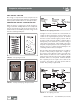
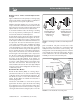
The function of the ADB is to convert the air pressure
applied when the driver applies the brakes into braking
force against the rotor on the vehicle wheel. This is done
by the application of air from the foot brake or relay valve
entering the brake chamber causing the plate to move the
push rod outwards. The push rod exerts force on the
lever (see Figure 17) and this force is transferred and
multiplied as it turns around the eccentric bearing. The
bearing and the connected actuating beam move outward,
overcoming the force of the two return springs. The force
is then transferred to the two threaded tubes, tappets
and finally to the inner and outer brake pads.
FIGURE 17 - Air Disc Brake - Cut-away View
Lever
Rotor
Eccentric
Bearing
Inner Brake Pad
Outer
Brake Pad
Actuating
Beam
Return Springs
Actuator Push Rod
Supply
Port
Diaphragm
Brake
Chamber