
Troubleshooting guide

56
www.bendix.com 1-800-AIR-BRAKE (1-800-247-2725)
Air Brake System Balance
The air brake system is one of the most important safety
system on a vehicle. Air brake systems are carefully
designed with valves, tubing or hoses, etc., selected to
result in balanced vehicle braking performance - one
where all the brakes apply as close to simultaneously
as possible and with the desired amount of force.
Proper vehicle maintenance will result in the original
performance being retained and so component
replacement and general brake system maintenance are
very important. Routine system maintenance
operations should be performed with this in mind.
Two major areas that we cover here are:
I. Pneumatic (Air) and II. Mechanical.
I. Pneumatic (Air) Systems
General
An ideal or balanced braking system is one in which
the braking pressure reaches each actuator as close to
simultaneously as possible and at the same pressure
level (and at an appropriate level to achieve torque
balance with respect to the axle’s loading).
Transmission Time
Vehicle manufacturers must comply with the air system
timing requirements of Government regulations (e.g.
U.S. FMVSS 121, Canadian CMVSS 121). In establishing
this performance, vehicle manufacturers carefully select
tubing and hose sizes. Air application and release
performance is partially dependent upon the size and
volume of chambers, vehicle weights and locations of
the valves and chambers, or distance the air must travel.
Performance is engineered into the vehicle by the
manufacturer; the role of the vehicle owner and/or
mechanic is to preserve that pneumatic performance.
Here are a few tips to assist in that effort.
Tubing
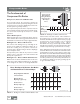
When replacing tubing or hose, always replace with
DOT or SAE approved tubing of the same size. These
sizes have been determined by the vehicle manufacturer
to obtain desired performance. If copper tubing is used,
always make sure to ream and de-burr the tubing after
cutting. Check carefully for restrictions such as kinking
or bending, and make sure tubing and hoses are
properly supported. Use the proper size fittings and
make certain they are not restricted. As a rule, do not
replace straight fittings with elbows. Note: it takes as
much time for air to flow through an elbow fitting as
through 6-7 feet of tubing or hose.
Valving
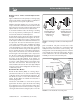
When replacing valves in the air brake system, be sure
that the function of the replacement valve is comparable
with the valve being replaced. Wherever possible, we
recommend genuine Bendix parts be used. Then you
can ensure that the new valve is equal in performance
to the original. Bendix adheres to an industry
recommendation which requires that, for some valves,
the valve type and some of its critical characteristics
are identified by a metal tag or washer to help select
the correct replacement. (For example: relay valve
crack pressures.)
Air System Contamination
Air brake systems need clean air to function at their
best. Almost all vehicles with air brakes now use an air
dryer to remove contaminants from the air before it
enters the system.
A properly maintained desiccant-type air dryer will
remove almost all the water vapor and oil droplets
present in the compressed air arriving from the air
compressor.
Typically, air dryer cartridge replacement intervals are:
• Every 3 years/300,000 miles for a low air use vehicle
(e.g. line haul, single trailer, with 5 or less axles) or,
• Every year/100,000 miles for a high air use vehicle
(e.g. refuse truck, transit bus, bulk unloader, or line
haul with 6 or more axles.)
A properly maintained air dryer will substantially reduce
the potential for freeze-ups in the system.
If for some reason an air dryer is not in use, daily
reservoir draining can help reduce the amount of
contamination in the system. While reservoir draining
can not eliminate valve contamination, it can reduce
the amount.
Trailer Air System Contamination
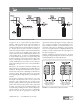
Contamination by insects, fibrous material, etc. can
affect trailer air brake systems. The Cyclone
DuraDrain
™
trailer water separator installed in the
trailer control and/or supply lines near the gladhands
where it self-purges liquid contaminates, contains solid
contaminants and improves the life of the trailer system
components. Other Bendix products that work to help
trailer air system are: the AF-3
™
in-line air filter screens
out foreign material from trailer air lines; and the
System-Guard
®
trailer air dryer which removes
moisture and contaminates from the trailer air system.
Air Brake System Balance: Pneumatic Systems