
Boss RC-505 MKII Loop Station
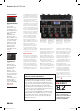

TRACKS: Eminently
playable backlit controls
loop record/overdub/
playback, track editing
and effect toggling, plus
a fader for track level
INPUT FX: Four effects
in four banks assignable
to any/all inputs.
49 effects types are
available, each with a
parameter assigned to
the FX knob
TRACK FX: Four effects
blocks in four banks, 53
effect types. The backlit
buttons A-D toggle
effects on/off and select
slots/banks for editing
via the LCD display
DISPLAY: Four rotary
encoders to tweak
parameters and navigate
sub-menus. Buttons
either side access major
programming areas
four backlit FX buttons beneath each
of the large knobs that bookend its
upper section. This may only be one
extra effect per section but the Edit
button above turns the A-D buttons
into bank selectors so that 16
different effect types can be assigned
per program to each of the two effect
blocks. The effects can be globally
applied to whichever track has its FX
button lit, or individually assigned to
one of the tracks/inputs. The number
of effects has also expanded with 49
available on the Input side and 53 on
the Track side. As you can imagine,
this is an all but exhaustive collection
that runs the gamut from simple
distortions and fi lters to a pattern
slicer and pitch/harmony effects.
Each has anything from two to ten
pages of parameters, though the ten
pager is for handling the 16 steps of
the step slicer. It may seem
overwhelming but they are easy to
tweak to taste, and in use a well
set-up pair of FX blocks become
integral to the process, particularly
when the main knobs are called on
for fi lter sweeps, pitch shifts, etc.
Buried treasure
Beneath all of this, hidden away in
the black housing, a huge expansion
has occurred. Though there are still
99 memory slots they now get to
share a total of around 13 hours of
recording time at 32-bit 44.1kHz
resolution; the original had three
hours at 16-bit 44.1kHz. The data
processing resolution is matched by
the AD/DA conversion, and though
human hearing can’t match the
navigation, tap tempo, rhythm start/
stop, effects control, input mutes and
various individual track functions. Via
MIDI, the RC-505 MkII can transmit
and receive clock/tempo, program
changes and control changes, the
latter part of a comprehensive 16 slot
control assignment sub-menu.
The RC-505 MkII may exude a
jolly Christmas tree vibe but it is a
formidable powerhouse of looping
and layering with enough
functionality and fl exibility to grow
with dedicated users. It can be used
for a large range of performance,
composition and experimentation
tasks and benefi ts from an easy to
use control set that draws users in.
This is a professional tool that can
inspire creativity as easily as it can
capture it. There is a lot on offer for
the kind of sensible price one expects
from Boss.
FM VERDICT
8.2
Boss have extended and
enhanced their fl agship
desktop loop station without
compromising its original
quality and playability
dynamic range this allows, it does
mean that quiet signals can be
boosted without the digital noise fl oor
or dithering becoming an issue. The
onboard rhythm section is also
generous, whether used for initial
recording or actual performance, and
there’s plenty of room for expansion
via the USB connection (see ‘USB
Mass Storage and Interface').
Additional control of the RC-505
MkII comes in the form of two
expression/footswitch sockets and old
school 5-pin DIN socket MIDI. The
former can be assigned to a range of
tasks such as memory slot
USB MASS STORAGE AND INTERFACE
The RC-505 MkII USB socket has two utilities: data
import/export and audio/MIDI interfacing. Considering
the ~13 hours of recording time, running out of space
may not be an issue for a while, but archiving, organising
memory slot orders for performance and shipping in
loops from other sources may well be. Also, it is possible
to process loops on your computer to drop back into the
looper, or move loops to different tracks.
As an interface the RC-505 MkII can work with your
DAW and other apps with MIDI control on the side. The
Loop Station can route the incoming USB audio to its
line-out or sub mix, or use it as a loop input, which is
where the real fun lies.
THE ALTERNATIVES
Electro-
Harmonix 95000
$595
The six-track
Performance Loop
Laboratory hosts a
not-dissimilar feature
set to the RC-505
MkII with
footswitches that
give it some fl oor-
based potential. Less
visual feedback and
no effect section(s)
makes this a more
raw looper, though
there’s plenty of
fl exibility via the
USB, MIDI and SD
card slot.
ehx.com
HeadRush
Looperboard
£721
A deluxe looper
which can’t decide
whether to live on
the fl oor or the
desktop – it has
footswitches and a
7” hi-res multi-touch
display. Four tracks,
MIDI/USB
connectivity, built-in
drum/percussion
loops and effects
put it in the RC505
MkII ballpark.
headrushfx.com
Reviews | Boss RC-505 mkII
74
FMU380.rev_boss_rc.indd 74FMU380.rev_boss_rc.indd 74 23/01/2022 16:2323/01/2022 16:23