USER’S GUIDE Please keep all information for future reference. English ES GUÍA DEL USUARIO Guarde toda información para tener como referencia futura. Precauciones de seguridad Antes de intentar usar el teclado, asegúrese de leer las “Precauciones de seguridad” separadas. LK230ES1A Español Safety Precautions Before trying to use the keyboard, be sure to read the separate “Safety Precautions”.
NOTICE This equipment has been tested and found to comply with the limits for a Class B digital device, pursuant to Part 15 of the FCC Rules. These limits are designed to provide reasonable protection against harmful interference in a residential installation. This equipment generates, uses and can radiate radio frequency energy and, if not installed and used in accordance with the instructions, may cause harmful interference to radio communications.
General Guide ............................. E-2 Using the 10-key Pad (bo) .................................E-4 Using the Setting Button (4) .............................E-4 Using Built-in Songs to Master Keyboard Play .............. E-21 Phrases............................................................ E-21 Step Up Lesson Flow....................................... E-21 Selecting the Song, Phrase, and Part You Want to Practice................................ E-22 Lessons 1, 2, and 3......................
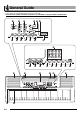
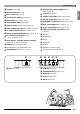
General Guide • In this manual, the term “Digital Keyboard” refers to the LK-230. • In this manual, buttons and other controllers are identified using the numbers shown below.
General Guide ☞E-17, 18, 20, 23, 24, 29 bm PART SELECT, ACCOMP ON/OFF, CHORDS button ☞E-17, 20, 22, 24, 30, 36 bn TEMPO buttons ☞E-10, 19, 33 bo Number buttons, [–] / [+] buttons ☞E-4 bp SONG BANK button ☞E-17, 19, 22, 27 dl dl USB port ☞E-34 bq RHYTHM, ONE TOUCH PRESET button ☞E-9, 11, 29, 33 English 1 POWER switch ☞E-6 2 MAIN VOLUME slider ☞E-6 3 MIC VOLUME slider ☞E-13 4 SETTING, KEY LIGHT button ☞E-4, 8 5 SAMPLING button ☞E-13, 14, 16 6 METRONOME, BEAT button ☞E-9 7 REPEAT, INTRO button ☞E-18, 1
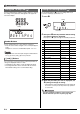
General Guide Using the 10-key Pad (bo) Use the number buttons and the [–] and [+] buttons to change the settings of the parameters that appear in the upper left area of the display. Using the Setting Button (4) Use the Setting button (4) to access settings that let you select the reverb type, pedal effect, etc. 1. Press 4. Setting Trans . Setting Parameter Md e r nPn o 2. Next press 4 until the parameter whose setting you want to change is displayed.
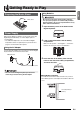
Preparing the Music Stand Music stand English Getting Ready to Play Using Batteries • Be sure to turn off power before loading batteries. • It is up to you to prepare six commercially available AA-size batteries. Do not use oxyride batteries or any other nickel based batteries. 1. Open the battery cover on the bottom of the Digital Keyboard. Power Supply Either an AC adaptor or batteries can be used to power this Digital Keyboard. Normally, use of AC adaptor power is recommended.
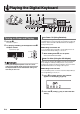
Playing the Digital Keyboard 1 2 4 6 bo bl Turning on Power and Playing 1. Turn on 1. This turns on power. 2. Try playing something on the keyboard. Use 2 to adjust volume. Keyboard keys light. Increase bn bq br bs bt ck cl cm cn Auto Power Off (Using Batteries) While you are using batteries for power, power will turn off automatically if you do not perform any operation for about six minutes. Auto Power Off is disabled while the AC adaptor is being used for power.
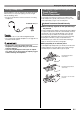
Using Headphones Using headphones cuts off output from the built-in speakers, which means you can practice playing even late at night without disturbing others. • Be sure to turn down the volume level before connecting headphones. PHONES/OUTPUT jack Changing Keyboard Response to Touch Pressure (Touch Response) Touch Response alters tone volume in accordance with keyboard pressure (speed). This provides you some of the same expressivity you get on an acoustic piano.
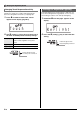
Playing the Digital Keyboard Changing Touch Response Sensitivity Use the procedure below to control how much the volume of played notes change in accordance with playing speed. Select the setting that best matches your playing style. 1. Press 4 a number of times until “Touch” appears on the display (page E-4). Touch 2. Use bo (10-key) [–] and [+] keys to select one of the three Touch Response sensitivity settings. Off (oFF) Touch Response is turned off.
Playing the Digital Keyboard You can use the voice pads to sound various sound effects or even sounds you have sampled (“Sampling”, page E-13). Use the voice pads to add something extra to your performances. Sounding Sampled Sounds with the Voice Pads Sampling sounds will change the tones assigned to sets 1 through 3 to the sampled sounds. For more information, see page E-13. 1. Press bq.
Playing the Digital Keyboard Changing the Metronome Tempo Use the following procedure to change the tempo of the metronome. 1. Press bn. Use y (slower) and t (faster) to change the tempo setting. Holding down either button changes the setting at high speed. • Pressing y and t at the same time will initialize the tempo setting in accordance with the currently selected song or rhythm. • Pressing bn causes the tempo value to flash on the display.
3 English Controlling the Keyboard Sounds 45 bo bq br bs bt ck cl cm Select from a variety of musical instrument sounds 3. Try playing something on the keyboard. The tone of the instrument you selected will sound. Your Digital Keyboard lets you select tones for a wide variety of musical instrument sounds, including violin, flute, orchestra, and more. Even the same song sound takes on a different feel by changing the instrument type. To select an instrument for playing 1. Press br.
Controlling the Keyboard Sounds Using Reverb Reverb adds reverberation to notes. You can change the duration of the reverb. Selecting the Pedal Effect 1. Press 4 a number of times until “Jack” appears on the display (page E-4). 1. Press 4 a number of times until “Reverb” appears on the display (page E-4). Jack Reve r b 2. Use the bo (10-key) [–] and [+] keys to select the reverb setting you want. Off (oFF) Turns off reverb. 1 to 10 The larger the number selected, the longer the reverb duration. 2.
Changing the Pitch (Transpose, Tuning) Changing the Pitch in Semitone Steps (Transpose) The transpose feature lets you change the pitch, in semitone steps. A simple operation lets you instantly change the pitch to match that of a singer. • The transpose setting range is –12 to +12 semitones. 1. Press 4. Sampling a Sound and Playing It on the Keyboard (Sampling) You can use the Digital Keyboard to sample a sound from a microphone, and then play the sound with the keyboard keys or voice pads.
Controlling the Keyboard Sounds 5. Output the sound from the microphone. The Digital Keyboard will start sampling automatically, and stop after one second. What you sample is stored as tone number 401. Flashes Sam l i n p g Lights Or i g i na l 6. Try playing something on the keyboard. • You can press pad 4 or 5 (cl or cm) to sound the sampled sound (page E-9). • Sampling will not start if the volume of the sound picked up by the microphone is too low.
Controlling the Keyboard Sounds Applying Effects to a Sampled Sound Turning off power will causes all sampled sound data to be deleted. You can use the following procedure to apply various settings to the sampled tone assigned to tone number 401. ■ How sampled sounds are played 1. Use bo (10-key) to select a tone number from Pressing Middle C (C4) will play back the original sound. The keys to the left and right of C4 play the sound at different pitches. 405 to 414.
Controlling the Keyboard Sounds Using a Sampled Sound in a Rhythm (Drum Assign) Use the following procedure to replace a percussive instrument with a sampled sound you sampled with short sampling and play auto accompaniment rhythms (page E-29) with it. 1. Press 4 and 5 at the same time. Lights D r mA s i g n The display will return to the previous screen if you do not perform the next step for some time. 2. Use the bo (10-key) [–] and [+] keys to select the drum assign type you want.
English Playing Built-in Songs 4 bo 7 8 9 bk bl bm With this Digital Keyboard, built-in tune data is referred to as “songs”. You can listen to the built-in songs for your own enjoyment, or you can play along with them for practice. • In addition to simple listening enjoyment, the built-in songs can be used with the lesson system (page E-21) for practice. Playing the Demo Songs bn bp Playing Back a Particular Song Use the procedure below to play back one of the built-in songs.
Playing Built-in Songs 3. Press bl. ■ Skip Forward This starts playback of the song. Keyboard keys will light as notes are played. Sustain pedal Key Note Mo o n l i g Tempo Measure h 1. Press 9. This skips song playback forward to the next measure. Each press of 9 skips ahead one measure. Holding down 9 skips forward at high speed until you release it. • Pressing 9 while song playback is stopped performs lesson function phrase skip forward (page E-22). Fingering Beat 4.
Playing Built-in Songs This specifies the measure as the end measure and starts repeat playback of the measures in the specified range. • During repeat play you can use bk to pause playback, 9 to skip forward, or 8 to skip back. Lights Tw i n k l e 4. Pressing 7 again returns to normal playback. Changing the song number clears the start measure and end measure of the repeat operation.
Playing Built-in Songs Turning Off the Part of One Hand for Practice (Part Select) You can turn off the right hand part or the left hand part of a song during playback and practice playing the along with the remaining part. 1. Press bm to select the part you want to turn off. Each press of bm cycles through the settings shown below. Right hand part off Left hand part off Both hand parts off Both hand parts on 2. Press bl. This starts playback in accordance with the setting you selected in step 1.
English Using Built-in Songs to Master Keyboard Play 4 bo 789 bl bm To master a song, it is best to break it up into shorter parts (phrases), master the phrases, and then put everything together. Your Digital Keyboard comes with a Step Up Lesson feature that helps you to do just that. Phrases The built-in songs are pre-divided into phrases to help you master keyboard play. Song start Phrase 1 Song end Phrase 2 Phrase 3 . . . .
Using Built-in Songs to Master Keyboard Play Messages that Appear during Lessons The following are the messages that appear on the display during Step Lessons. Message Description Appears when you select a phrase, when a lesson starts, etc. • Note that certain phrases will cause “Wait” to appear instead of “Phrase”. Appears when the lesson starts with an intro or fill-in phrase that is not included in the phrases to be practiced.
Using Built-in Songs to Master Keyboard Play Now it is time to start the lessons. First, select the song and part you want to practice. Lesson 1: Listen to the song. the instructions provided on the display and by voice fingering guide. During this lesson, the display shows the key you need to press next. Voice fingering guide uses a simulate voice to announce which finger you should use. First, listen to the example a few times to familiarize yourself with what it sounds like. 1. Press bs.
Using Built-in Songs to Master Keyboard Play Lesson 3: Remember what you learned as you play. Though song playback stands by waiting for you to press the correct keys as in Lesson 2, the Digital Keyboard does not provide any guidance about what note you need to play next. Remember everything you have learned up to Lesson 2 as you play. 1. Press ck.
Using Built-in Songs to Master Keyboard Play Turning Off Note Guide 1. Press 4 a number of times until “NoteGuid” appears on the display (page E-4). With Auto Step Up Lesson, the Digital Keyboard advances through each lesson automatically. 1. Select the song and part you want to practice (page E-17). 2. Press cm. No t eGu i d 2. Press the bo (10-key) [–] key to select the OFF Listen to the first phrase in Lesson 1. • In Lesson 1, the sample phrase is played only once before advancing to Lesson 2.
Using Built-in Songs to Master Keyboard Play ■ Auto Step Up Lesson Procedure Phrase 1 Lesson 1 4 Lesson 2 4 Lesson 3 4 Phrase 2 Lesson 1 4 Lesson 2 4 Lesson 3 4 Phrase 1, 2 • Lesson 3* 4 Phrase 3 Lesson 1 4 Lesson 2 4 Lesson 3 4 Phrase 1, 2, 3 • Lesson 3* 4 Next phrase practice using the same procedure 4 Final phrase Lesson 1 4 Lesson 2 4 Lesson 3 4 From Phrase 1 to the final phrase • Lesson 3* 4 Lesson complete * Auto Step Up Lesson advances to the next phrase, regardless of whether the “Bravo!” resul
English Music Challenge Keyboard Game 1 bl Music Challenge is a game that measures your reaction speed as you press keys in response to keyboard keys that light and to on-screen fingering guide indications. 1. Press bp. 2. Press cn. This causes a keyboard key to start flashing, and starts the Music Challenge song. bp bq br cn 3. After the keyboard key changes from flashing to lit, press the key with the finger indicated on the screen as quickly as possible.
Music Challenge Keyboard Game 4. The game ends when you advance successfully through 20 notes. • Your score and playing time appear on the display. After a short while, the playing time display changes to an evaluation result. To clear the evaluation result from the display, press bp, bq, or br. • You can cancel a game at any time by pressing cn or bl. Score T i me 1 9 .
English Using Auto Accompaniment 4 bo 7 8 9 bk bl bm With Auto Accompaniment, simply select an accompaniment pattern. Each time you play a chord with your left hand the appropriate accompaniment will play automatically. It’s like having a personal backup group along with you wherever you go. bn bq Starting and Stopping the Rhythm Part Only 1. Press bq. Rhythm number • Auto Accompaniments are made up of the following three parts.
Using Auto Accompaniment 5. Pressing bm again returns to rhythm only Playing All Parts accompaniment. Auto Accompaniment with Chords Playing a chord with your left hand automatically adds bass and harmony accompaniment parts to the currently selected rhythm. It is just like having your own personal back up group on call. 1. Start play of the Auto Accompaniment rhythm part. 2. Press bm. This enables chord input on the accompaniment keyboard.
Using Auto Accompaniment With these three input modes, you play chords on the accompaniment keyboard using their normal chord fingerings. Some chord forms are abbreviated, and can be fingered with one or two keys. See the separate “Appendix” for information about chords that are supported and how they are fingered on the keyboard. Accompaniment keyboard ● FINGERED 1 Play the component notes of the chord on the keyboard. ● FINGERED 2 Unlike FINGERED 1, 6th input is not b possible. m7 or m7 5 is input.
Using Auto Accompaniment Using Auto Accompaniment Effectively Auto Accompaniment Pattern Variations Use the following procedures to play intro and ending patterns, to play fill-in patterns, and to play variations of basic Auto Accompaniment patterns. ■ Auto Accompaniment Variation Each Auto Accompaniment pattern has a basic “normal pattern” as well as a “variation pattern”. 1. Press 9. ■ Auto Accompaniment Fill-in Use the procedure below to play a fill-in pattern during a performance.
Using Auto Accompaniment Use the following procedure to configure the Digital Keyboard to start Auto Accompaniment play as soon as you press a keyboard key. 1. Press bk. This enters accompaniment start standby. Adjusting the Accompaniment Volume Use the following procedure to adjust the balance between what you are playing on the keyboard and the volume of the Auto Accompaniment. 1. Press 4 a number of times until “AcompVol” appears on the display (page E-4). Flashes A c ompVo l 2.
Connecting External Devices 4 bo bm Connecting a Computer You can connect the Digital Keyboard to a computer and exchange MIDI data between them. You can send play data from the Digital Keyboard to music software running on your computer, or you can send MIDI data from your computer to the Digital Keyboard for playback. Minimum Computer System Requirements The following shows the minimum computer system requirements for sending and receiving MIDI data.
5. Configure the music software settings to select one of the following as the MIDI device. MIDI Settings CASIO USB-MIDI: (For Windows Vista, Mac OS X) USB Audio Device: (For Windows XP) Keyboard Channel • For information about how to select the MIDI device, see the user documentation that comes with the music software you are using. • Be sure to turn on the keyboard first before starting up your computer’s music software.
Connecting External Devices ■ Turning Off the Navigate Channel Sound and Playing the Part on the Keyboard You can turn off the sound on one or both of the navigate channels and play the cancelled part on the keyboard yourself. 1. Press bm to select the channel setting you want to turn off. Each press of bm cycles through settings (1) thorough (4) described below. • If you turn off one channel, you can play the cancelled part on the keyboard using the same tone as the channel you turned off.
Connecting External Devices Connecting to Audio Equipment English This keyboard can be connected to commercially available stereo, amplifier, or recording equipment, to a portable audio player or other equipment. Outputting Keyboard Notes to Audio Equipment Connection requires commercially available connecting cords, supplied by you. The connecting cords should have a stereo standard plug on one end and a plug that matches the configuration of the external device on the other end.
Reference Troubleshooting Symptom Action Included Accessories I can’t find something that should be here. Carefully check inside all of the packing materials. Power Requirements Power will not turned on. • Check the AC adaptor or make sure that the batteries are facing correctly (page E-5). • Replace the batteries with new ones or switch over to AC adaptor power (page E-5). The Digital Keyboard outputs a loud sound and then suddenly powers down.
Symptom Action Some notes are cut off while they are playing. Notes are cut off whenever the number of notes being sounded exceeds the maximum polyphony value of 48 (24 for some tones). This does not indicate malfunction. See “Maximum Polyphony” in the “Tone List” in the separate “Appendix”. The volume or tone setting I made has changed. • Adjust the main volume setting (page E-6). • Turn power off and then back on to initialize all keyboard settings (page E-6).
Reference Specifications Model Keyboard Touch Response Key Light System Maximum Polyphony LK-230 61 standard-size keys 2 types, Off Up to 4 keys can be lit at the same time 48 notes (24 for certain tones) Tones Built-in Tones 400 Sampling Tones 1 (Full Sampling) or 3 (Short Sampling) Sampling Time: 1 second (Full Sampling) or approximately 0.
Dimensions 94.9 × 35.7 × 11.8 cm (37 3/8 × 14 1/16 × 4 5/8 inch) Weight Approximately 4.2kg (9.3 lbs) (without batteries) English Reference • Design and specifications are subject to change without notice. Operating Precautions Be sure to read and observe the following operating precautions. ■ Location Avoid the following locations for this product.
E-42 Root C C#/(Db) D (D#)/Eb E F F#/(Gb) • Since the chord input range is limited, this model may not support some of the chords shown above.
Key’s Ch’s After Touch Control Change Pitch Bender Note ON Note OFF Velocity True voice 0, 32 1 6, 38 7 10 11 64 O X X O O X O *3 X O (MSB only) O O *2 O O O O O X O O 9nH v = 1 - 127 X 9nH v = 0, 8nH V =** O 9nH v = 1 - 127 X 9nH v = 0 X X 0 - 127 0 - 127 *1 Mode 3 X 1 - 16 1 - 16 Recognized 36 - 96 Mode 3 X Default Messages Altered Mode Note Number 1 1 - 16 Default Changed Transmitted MIDI Implementation Chart Basic Channel Function Model: LK-230 Bank select Modulation Data
:True # : Clock : Commands : Local ON/OFF : All notes OFF : Active Sense : Reset System Real Time Aux Mode 1 : OMNI ON, POLY Mode 3 : OMNI OFF, POLY Remarks Messages : Song Pos : Song Sel : Tune System Common System Exclusive Program Change 66 67 91 100, 101 120 121 Mode 2 : OMNI ON, MONO Mode 4 : OMNI OFF, MONO *1:Depends on tone. *2:RPN : Pitch Bend Sensitivity, Fine Tune, Coarse Tune *3:In accordance with pedal effect setting.
This recycle mark indicates that the packaging conforms to the environmental protection legislation in Germany. Esta marca de reciclaje indica que el empaquetado se ajusta a la legislación de protección ambiental en Alemania.