
Technical data





36
Gas Connection
The installation of the gas appliance to Natural Gas or LP Gas must be carried out by a suitably qualied and
registered installer. Installers shall take due account of the provisions of the relevant British Standards Code of
Practice, the Gas Safety Regulations and the Building Standards (Scotland) (Consolidation) Regulations issued
by the Scottish Development Department.
Installation to Natural Gas
Installation to Natural Gas must conform to the Code of Practice, etc.
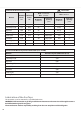
The supply pressure for Natural Gas is 20 mbar.
The installation must conform to the relevant British Standards.
Installation to LP Gas
When operating on Butane gas a supply pressure of 28-30 mbar is required.
When using Propane gas a supply pressure of 37 mbar is required.
The installation must conform to the relevant British Standards.
Warning: Only a suitably qualied and registered installer, also with technical knowledge of electricity should
install the appliance. He should observe the Regulations and Codes of Practice governing such installation of
gas appliances.
Note: It is recommended that the gas connection to the appliance is installed with a exible connecting tube
made to BS5386.
Notes:
• Flexible hoses can be used where the sited ambient temperature of the hose does not exceed 70°C.
These hoses must be manufactured in accordance with BS669 part 1 and be of the correct con-
struction for the type of gas being used.
• Gas hoses designed for natural gas MUST NOT be used for supplying LPG gas (LPG gas hoses can be
identied by a either a red band or stripe on the rubber outer coating of the hose). The hose should
not be crushed or trapped or be in contact with sharp or abrasive edges.
Using a suitable leak detection uid solution (e.g. Rocol) check each gas connection one at a time by brushing
the solution over the connection.
The presence of bubbles will indicate a leak.
If there is a leak, tighten the tting and then recheck for leaks.
IMPORTANT!
Do not use a naked ame to test for leaks.