
Specifications




Operating Manual Freeze Dryer ALPHA 1-4 LD-2 / 2-4 LD-2, Version 0203, Page 14
2.5 Defrosting Water
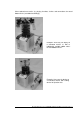
The defrosting water is drained via the condensate drain valve on the left side of the
unit. To drain the water place the hose supplied with the unit onto the nozzle. The
defrosting water is collected in a vessel.
The defrosting water can also be drained directly via this hose. The defrosting water
must be able to drain freely. To achieve this the hose must have a steady downward
slope. It must be ensured that water does not collect in any part of the hose. The end
of the hose always has to be above the level of the liquid in the vessel for the
discharged defrosting water. Otherwise there is the risk of water and dirt residues
being sucked into the condenser chamber if there is a vacuum when opening the
condensate drain valve.
2.6 Vacuum Pump Exhaust
During the main drying phase the vacuum pump must be operated with open gas
ballast valve. The oil mist which is produced must be removed.
A ½ " hose is connected to the exhaust flange of the vacuum pump RZ-2 or RC-5 and a
¾ " hose is connected to the exhaust flange of the vacuum pump DUO 005 or DUO
010. The hose either leads into the open air or into a vent.
During installation of the pipe care must be taken that condensate cannot flow back
into the pump. With upward leading pipes it is safest to use a separator (Woulfe's
bottle or wash bottle) in the pipe.
If draining of the oil mist should not possible we recommend that an exhaust filter (oil
mist separator) is fitted. This filter prevents air pollution by oil mist which is emitted by
the vacuum pump in smaller or larger quantities depending on the working pressure.
The filter is fastened to the exhaust flange of the vacuum pump.
The filter is equipped with a pressure control valve which indicates the saturation of the
filter. Cleaning or replacing of the filter insert must be carried out at the latest when the
pressure control valve is activated. The collected oil is visible in the inspection glass
and is drained via the discharging screw.
(Please refer to separate operating manual of the vacuum pump!)