
Installation Manual Part 5
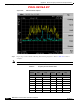

Table Of Contents

PRELIMINARY
D-11
BWX 8415 Basestation Installation and Commissioning Guide
OL-19519-01
Appendix D RF Center Frequency and Interference Analysis Guidelines
Spectrum Analyzer Settings
Step 1 Program the initial Spectrum Analyzer settings, per the following:
a. Resolution Bandwidth = 30 KHz
b. Video Bandwidth = 30 KHz
c. Attenuation = 0 db
d. Ref Level = -50 db
e. Sweep Time = auto
f. Detector Mode = positive peak
g. Frequency = determined by which step you are on in the procedure
Step 2 Set the frequency sweep range, as follows. This depends on the frequency you are investigating.
a. Licensed 2.6 GHz = sweep for range 2.596 GHz to 2.644 GHz
b. Other Licensed Frequencies (i.e., 2.3, 2.5, 3.4, 3.5 GHz) = sweep the center frequency plus 6
MHz to check for adjacent channels
Step 3 Proceed to the “Interference Sweep Procedure” section of this document.
Post-installation Test
The post-installation test is used to help verify the operational frequency that the BS will use. If the
system performance has degraded, this test can determine if there is another carrier causing problems in
the RF environment.
Required Equipment
• Spectrum Analyzer (4404 or R&S FSH)
• BWX Basestation antenna
• RF cable connected to antenna
• RFS Test Box
• External LNA, as required
Set-up
Refer to Figure D-9 for the setup. In this setup, the BWX Basestation antenna is installed on the tower
or building. The RF main feeder cable connects to the optional LNA or to the Spectrum Analyzer. The
LNA may be required to add gain to the system to compensate for any losses that are added to the test
by the RF cable or Spectrum Analyzer. The typical loss for a Spectrum Analyzer is around 30 dB. The
RF cable losses will vary depending on the size and type of cable and on the length of the cable. In this
example, the total system loss would be 19 dB.
Example:
- Antenna Gain: 20 dBi
- Cable Loss: 9 dB
- Loss in Spectrum Analyzer: 30 dB
Using this example, with a loss of 19 dB, in order for the interference measurements to give an accurate
indication of the environmental noise, an additional gain of over 19 dBi needs to be injected into the test.