
User's Manual


Navini Networks, Inc. Ripwave Base Station I&C Guide
14
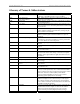
Term Stands For.... Meaning
dBi
Decibel/Isotropic A ratio, measured in decibels, of the effective gain of an
antenna compared to an isotropic antenna (measured along
axes in all directions). The greater the dBi value the higher the
gain and therefore the more acute the angle of coverage.
DHCP
Dynamic Host Configuration
Protocol
A protocol for dynamically assigning IP addresses to devices
on a network.
DiffServ
Differentiated Service Different Quality of Service (QoS) descriptions for different
types of traffic, i.e., voice, video, email. The DiffServ table is
where each level of QoS is defined. Equivalent to Class of
Service (COS) in POTS.
DIR
Directory A special kind of file used to organize other files into a
hierarchical structure.
DL
DownLink In this case, data messages transmitted from the BTS to the
Modem.
DNS
Domain Name Server TCP/IP networking term that is a protocol for matching objects
to network (IP) addresses.
DS-1
Digital Signal - 1 Also “T1” or “E1”. Digital transmission equipment that can
handle up to 1.544 Mbps.
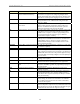
DSL
Digital Subscriber Line A type of service whereby users gain access to the Internet
through high-speed data networks.
DSP
Digital Signal Processing/Processor Compressing or manipulating analog signals to digital signals
and vice-versa.
EID
Equipment Identifier Field in EMS for assigning IP address or name to individual
pieces of equipment for purposes of configuring the system.
EMS
Element Management System An application that allows the user to define and manipulate
managed objects as a system within an overall network.
enet
Ethernet The most widely-installed local area network (LAN
)
technology. Ethernet is specified in the IEEE 802.3 standard
and typically uses coaxial cable or special grade of twisted pair
wires.
ERP
Effective Radiated Power The actual power in Watts radiated from a transmitter’s
antenna.
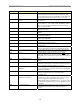
ESF
Extended Superframe In T-carrier, a synchronization frame that delineates 24 DS1
frames Note: ESF requires less frequent synchronization than
the T-carrier D4 superframe format. (See also D4.)
FCC
Federal Communications
Commission
United States government regulatory agency that supervises,
licenses and otherwise controls electronic and electromagnetic
transmission standards.
FE
Far End A relative term that refers to the receiving element in a
network, as opposed to the near-end element that is
transmitting data.
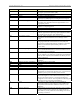
FEC
1
Forward Error Correction or
2
Fast Ethernet Controller
1
A system of error control for data transmission wherein the
receiving device has the capability to detect and correct any
character or code block that contains fewer than a
predetermined number of symbols in error.
2
A process created
and attached during BTS booting for the 10/100 Ethernet ports
on the BTS.
FTP
File Transfer Protocol A TCP/IP method consisting of a client and server and used to
transfer files between two or more sites or elements in a
network.