
User's Manual


Navini Networks, Inc. Ripwave Base Station I&C Guide
15
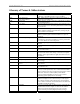
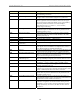
Term Stands For.... Meaning
Gain
Gain Ratio of the output amplitude of a signal to the input amplitude
of a signal, expressed in decibels (dB).
Gb
Gigabit One billion (1,000,000,000) bits.
GB
Gigabyte One billion (1,000,000,000) bytes.
GHz
Gigahertz One billion (1,000,000,000) hertz - cycles per second. Ultra
high frequency (UHF) signals, including microwave signals.
GPS
Global Positioning System A constellation of 24 well-spaced satellites that orbit the earth
and enable users with GPS antennas to pinpoint their exact
geographical position.
GUI
Graphical User Interface A graphic rather than purely text based user interface to a
computer or computing system.
HW
Hardware Physical, tangible equipment
Hz
Hertz 1 cycle per second.
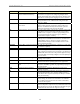
I&C
Installation & Commissioning Term used to describe the procedures of physically installing
technical equipment then powering up the equipment to make
sure it will operate (to put it “into commission”).
IEC
Inter-exchange Carrier Also IXC. Public switching network service provider (carrier)
that connects across and between local exchange carriers
(LEC).
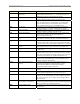
IF
Interface Card Card on the digital shelf of the Ripwave BTS that takes the
analog signal from the Channel Processor card (CHP) and
converts it to a baseband signal before sending it on to the RF
modules for transmission (forward link), and vice-versa
(reverse link).
IMA
Inverse Multiplexing over ATM A method of building dynamic routes of 2 or more T1s to
increase bandwidth so that PVCs can share the IMA resources,
as needed, for data transmissions.
inet
Internet A worldwide system of computer networks in which users at
any one computer can, if they have permission, get information
from any other computer (and sometimes talk directly to users
at other computers.)
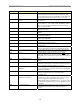
IP
Internet Protocol A TCP/IP protocol used to route data from its source to its
destination.
ISM
Industrial, Scientific and Medical Unlicensed band around 2.4 MHz
ISP
Internet Service Provider A company that provides access to the Internet.
Kb
Kilobit 1,024 bits
KB
Kilobyte 1,024 bytes
KHz
Kilohertz 1,000 hertz.
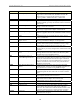
L1
Layer 1 Physical Layer. Part of the OSI rules and standards for network
management. L1 describes the physical layer, or electrical and
mechanical port-to-port connections, in the network.
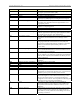
L2
Layer 2 Data Link Layer. Part of the OSI rules and standards for
network management. L2 describes the data link layer where
data is set up and torn down in a specific format (frames),
through the overall network. Also responsible for detecting and
correcting errors by requesting retransmission.
L3
Layer 3
N
etwork Layer. Pa
r
t of the OSI rules and standards for
network management. L3 describes the network addressing
that gets data to its destination within the network, i.e., IP
addressing.
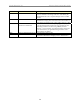
LAN
Local Area Network A data network of interconnected computers, servers, printers,
and other peripherals that communicate at high speeds over
short distances, usually within the same building. Also allows
for sharing of resources.