
User guide
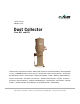

What is the Dust Collector?
Conair Dust Collectors keep your plant free of air-born dust and fines and prevent
dust from fouling the vacuum pump.
A central vacuum dust collector allows dust filtration to take place at floor level.
An air-tight collection container makes the removal of fines quick and easy.
Automatic filter cleaning is standard, lengthening the time between service require-
ments. DC1 and DC2 models use an integrated “popper valve” to remove dust
from the filter.
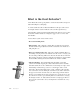
A dust collector system consists of four sections:
• Floor stand mounting frame.
• Filter chamber - This contains the cartridge filter, vacuum valve and solenoid.
The filter chamber is typically bolted to the floor stand, but can be mounted to a
wall, pump base, etc.
• Three-way vacuum breaker valve - This valve is mounted within the filter sec-
tion. During conveying it is closed to ambient air. At the end of a conveying cycle
the valve will open allowing ambient air to flow into the dust collector’s internal
filter causing a shock-wave effect loosening fines and dust that are trapped within
the internal filter, allowing the material to fall into the collection chamber.
• Collection Chamber - On a manual dump unit, this will be a removable
container for manually emptying the collected dust and fines. On an automatic
unload/reload unit, this is a two-chambered device that clamps on in place of the
manual dump container. The top section is a conical hopper, with a conical
unload valve. The bottom chamber is also conical, containing a take-away tube
and a solenoid air vent valve. During the vacuum load cycle, dust is collected in
the upper section. At the end of the load cycle, dust is dropped into the bottom
takeaway section. When the next load cycle begins, the conical valve closes and
the solenoid air vent valve opens, allowing dust to be sucked into the conveying
line through a diverter “Y” tube, back into the main receiving hopper. After 5 to
10 seconds, the solenoid valve closes, diverting all air to material in the convey-
ing system.
2-2 l Description