
Specifications




Chapter 1 - Overview RS-422 And RS-485 Applications Ebook
Page 6 of 137 Manual Documentation Number: <DocNumber>
www.bb-elec.com/
www.bb-europe.com/
Assumptions
This writers of this ebook have based the content and level of detail on
several assumptions. The first assumption is that the personnel reading
and using the information in it will have an understanding of basic
electricity and electronics. This includes an understanding of transistor
inputs and outputs, current sourcing and sinking, the differences
between analog and digital circuits, signal propagation, signal
inversion, digital rise and fall times, input and output impedance,
single-ended and differential voltage measurements, and other data
communication-related electronic concepts. Some explanation of these
concepts is included, but if the reader is unfamiliar with these areas,
some additional study may be required.
The writers also assume that the users of this ebook will come from
several different perspectives. Some may be using the material for
designing new communications systems; others will be using it in the
context of installing and commissioning systems; still others will be
involved in maintaining, expanding and troubleshooting problems
related to existing systems. This ebook may also be used in training
and upgrading personnel.
What is RS-422/RS-485?
RS-422 and RS-485 are the common names for two serial
communications standards. The standards, defined by the Electronics
Industry Association, are more correctly named EIA/TIA-422 and
EIA/TIA-485.
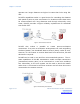
Communications systems based on RS-422 and RS-485 communicate
digital information over twisted pair wire from transmitters to
receivers. Devices can be up to 4000 feet (1220 meters) apart before
repeaters are required. RS-422 drivers can transmit to up to 10
receivers. Up to 32 RS-485 transceivers can occupy a bus. RS-422/485
systems can communicate at rates up to 10 Mbps (though most
systems operate at lower bit rates). Both systems utilize balanced
outputs and differential inputs, which provide better noise immunity
than single-ended systems such as RS-232. This results in the ability to