User manual


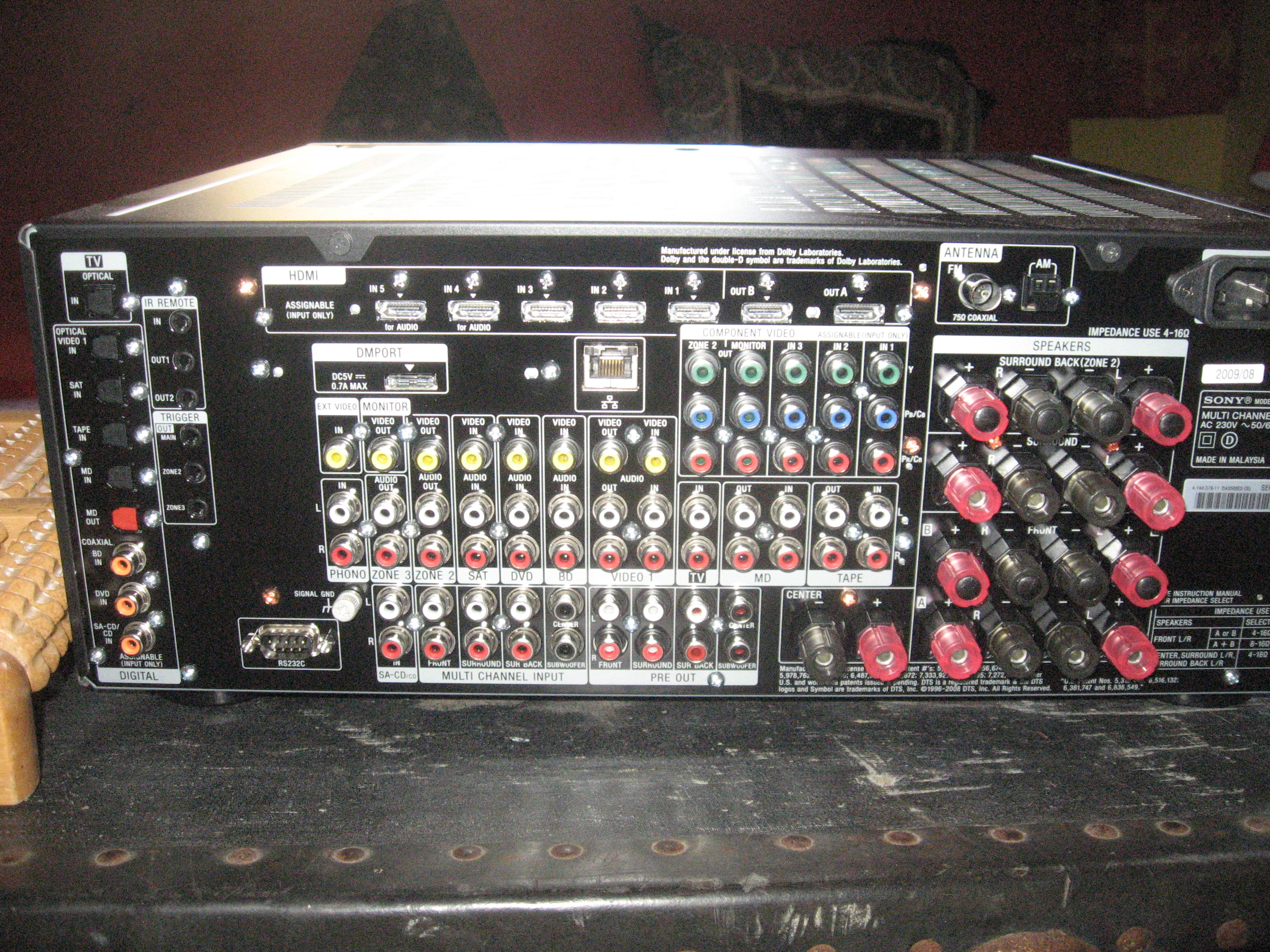
“bi-amp” setup where the tweeters and woofers in
acapably-wired pair of front speakers are amplified separately.
The limitation with this receiver is that there isn’t the ability to
have the crossover functionality or the amplifier levels managed
in abi-ampedsetup.
[3]
An example of very good connectivity options
The multi-zone feature also allows for yet another zone to be
catered fro as an audio-only stereo zone but with its own
amplifier. Similarly, the secondary zone can be amplified with
another amplifier. The line outputs for the extra zones are in fact
line-level outputs that are independent of the main volume
control and you would have to adjust the sound at the remote
amplifiers.
These setups also allow you to “scale up” your sound system as
you see fit and can afford the extra equipment. You can even
start with apair of good stereo speakers and, as you can afford
them, connect up extra speakers for your surround-soundsetup.
There are plenty of audio and video inputs for extra audio and
video equipment, Music enthusiasts are even catered for with
aphono input for agood turntable as well as two tape loops for
recording devices like cassette or MiniDisc decks. These same
connections can be used for connecting up acomputer’s sound
subsystem for recording vinyl or cassettes to the hard disk rather
than using those poor-quality USB turntables. Those music
enthusiasts who believe that the audio reproduction of
adedicated CD player connected to the analogue inputs is better
than that of aDVD or Blu-Ray player connected to the HDMI or
optical digital inputs of this receiver can connect the CD player
to these inputs.
The front panel provides walk-up connections for 1regular video
source (composite video, stereo analogue audio and optical
digital audio) and 1HDMI video source.
There is aDMPORT connection for use with optional
Sony-supplied modules that provide connection to and control of
various portable devices. These include Sony Walkman MP3
players, phones that have Bluetooth A2DP functionality like my
Nokia N85 as well as Apple iPods and iPhones..
For video displays, there is connection for two HDMI-equipped
video display devices so you can run aprojector or smaller
“operator-console” LCD screen alongside the regular
large-screen LCD or plasma display. The receiver also supports
video-signal conversion from regular video signals to HDMI
signals, which means no need to connect composite or
component cables to the main display to gain benefit from legacy
video sources.
Network AV
The receiver offers some network-enabled functionality but this
is limited to playback of DLNA media content with the user
controlling the receiver through its remote control and requiring
the video display attached to any of the monitor outputs being on
to select toe content. For radio functionality, the unit can only
work with Rhapsody or Shoutcast Internet radio services.
This network connectivity is made feasible by the receiver having
an Ethernet connection. This means that it can work also with
HomePlug AV powerline networks when you use aHomePlug
AV-Ethernet bridge; and is my preferred “no-new-wires”
network-connection method for connecting home-theatre and
hi-fi equipment to ahome network.
When you navigate aDLNA media server, you have to choose the
kind of content you are after – music, pictures or video. If you
browse around the same server for content outside the class you
selected, this receiver will not start any of that content.
It could be feasible to select audio content by using the receiver’s
built-in display and through the use of either the remote control
or controls on the unit’s front panel. For Internet-radio
functionality, it could be feasible to select Internet-radio content
from vTuner, RadioTime or Reciva directories which include
access to local radio from other countries.
Sound quality
The sound quality is as you would expect for high-end Sony gear,
where it is not coloured. Ieven noticed this with my computer’s
sound which was fed through the SACD/CD input and out
through the Preamp outputs to the SRS-DB500 speaker set.
Iswitched the unit in to regular 2-channel mode, then to
“analogue direct” to assess whether the digital circuitry was
colouring the sound. The receiver and the active speakers were
set to “tone-flat” – bass and treble at centre positions in order to
really assess how it sounded and Ihad played one of the early
“Café Del Mar” recordings from myPC.
The reason Iuse this kind of recording is to assess the equipment
from amature user’s viewpoint and find out how it handles music
other than aggressively-amplified pop music. In the context of
the home theatre, it would also include being able to yield the
whole soundtrack of amovie or TV series.
I haven’t been able to test the receiver with regular passive
speakers but the power amplifiers are something worth trying
out andusing.
13