
Specification Sheet

daylight
™
magnification explained
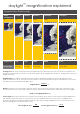
Magnification Relationships
Stamp 3 Diopter 5 Diopter 8 Diopter 12 Diopter 15 Diopter
unmagnified
0% 75% 125% 200% 300% 375%
Magnification 1.75X 2.25X 3.00X 4.00X 4.75X
Focal Length 33cm (13") 20cm (8") 12.5cm (5") 8cm (3.5") 6.5cm (2.6")
Viewing Area: The area of the lens surface through which the viewer sees the object in clear focus without any
distortion. It is important to note that, on our lenses, generally as magnification increases, viewing areas and focal
lengths decrease.
Magnification: The degree to which the viewed object is enlarged. Magnification is usually expressed by a
number followed by an "x", the symbol used to express power or the size of the object in relationship to its actual
size. The formula for calculation Magnification.
Diopter: Is related to the curvature of the lens. As the diopter increases, the lens has greater curvature. As the
curvature increases, the object fills a greater portion of the viewer’s retina which makes the object look bigger.
Focal Length: This is the optimal focus point from the middle of a lens surface to the object being magnified (it is
the distance where the object is at its sharpest). The focal length decreases as the diopter / magnification
increases. Therefore, with high magnification lenses, the object being magnified has to be much closer to the
lens (thus giving less room for hands and tools).
Magnification = +1
Diopter
4
Diopter = 4 x (Magnification +1)
Focal length (in cm) =
100
Diopter
Focal length (in inches) =
39.37
Diopter