
Instruction manual

22
22
RIPPING
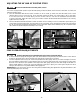
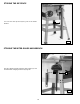
Ripping is the operation of making a
lengthwise cut through a board (Fig. 51) Use the rip fence
(A) to position and guide the work. Place the workpiece
so that one edge rides against the rip fence while the flat
side of the board rests on the table. Since the work is
pushed along the fence, it must have a straight edge and
make solid contact with the table. Use the saw guard.
The guard has anti-kickback fingers to prevent kickback,
and a splitter to prevent the wood kerf from closing and
binding the blade.
Start the motor and advance the work, holding it down
and against the fence.
Never stand in the line of the saw cut
when ripping.
Hold the work with both hands and push it along the
fence and into the saw blade (Fig. 51). Feed the work
through the saw blade with one or two hands. After the
work is beyond the saw blade and anti-kickback fingers,
remove your hand from the work. The work will either
stay on the table, tilt up slightly and be caught by the
rear end of the guard, or slide off the table to the floor.
Alternately, you can continue the feed to the end of the
table. Lift the work and bring it back along the outside
edge of the fence. Leave the cut-off stock on the table.
Do not touch it until the saw blade stops. When ripping
boards longer than three feet, use a work support at the
rear of the saw to keep the workpiece from falling off the
saw table.
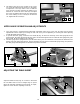
If the ripped work is less than 4 inches wide, use a push
stick to complete the feed (Fig. 52). The push stick can
be made from scrap material as explained in the section
“CONSTRUCTING A PUSH STICK.” When ripping
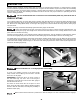
material under 2 inches in width, a use a flat pushboard
since ordinary push sticks may interfere with the blade
guard. The flat pushboard can be made as shown in Fig.
53.
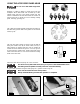
USING AN AUXILIARY WOOD
FACING ON THE RIP FENCE
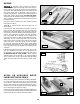
When performing special operations (moulding cutterhead,
etc.), add a wood facing (A) Fig. 54 to one or both sides
of the rip fence. Attach the wood facing to the fence with
wood screws through the holes provided in the fence.
Stock that is 3/4' thick is suitable for most work, although
an occasional job may require 1" facing.
Use the wood facing when ripping thin material (paneling,
etc.) to prevent the workpiece from catching between the
bottom of the rip fence and the saw table surface.
Fig. 51
A
Fig. 52
Fig. 53
Fig. 54
A