
Troubleshooting guide






2
United Air Specialists, Inc.
Supra-Blast
Cartridge Dust Collector
Revised 02/02
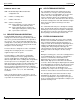
EXAMPLE: SBD 24-3-H55
SBD – DUST-HOG Supra-Blast double-filter
configuration unit
24 – number of cartridge filters
3 – number of filter tiers
H55 – unit base arrangement
H55 - hopper with 44" (112 cm) clearance for
standard 55 gallon (208 liter) drum
SD - hopper with 26" (66 cm) clearance for
UAS-supplied 30 gallon (114 liter) drum
OB - open bottom construction
2.2 DESCRIPTION AND OPERATION
The DUST-HOG Supra-Blast is a high-efficiency,
cartridge dust collector designed to eliminate airborne
dust as it is generated. Contaminants are captured at
the source(s), then conveyed through ductwork to the
cartridge filter section (dirty air section) where the dust
is collected. Clean air is then discharged from the unit
through the clean air discharge.
The dust collector is designed for on-line or downtime
cartridge filter cleaning by means of a customer-
supplied compressed air system.
The Supra-Blast is a high-efficiency, horizontally-
oriented cartridge dust collector equipped with 15"
(38 cm) outside diameter cartridge filters. The larger
diameter Supra-Max Series cartridge filter design allows
for lower pressure losses through the dust collector
while increasing the amount of media contained in each
filter. DUST-HOG Supra-Blast Series dust collectors
have pre-engineered backward-inclined or radial-type
optional blower packages in 3, 5, 7
1
/
2
, 10, 15, 20, 25 and
30 HP (2.2, 3.7, 5.5, 7.5, 11, 15, 18.5 and 22 kW)
assemblies.
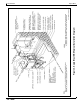
There are two primary modes of operation — the air
filtering operation and filter cleaning cycle. Both modes
of operation are shown in Figure 1.
2.3 AIR FILTERING OPERATION
The contaminated airstream is drawn into the dust
collector where its velocity is reduced by inlet baffle
plates to provide even air distribution across the entire
surface area of the cartridge filters. This design
enhances filtration efficiency by establishing a uniform
“dust cake” on the filters. The airstream is then directed
around the cartridge filters and down toward the hopper
where the heavier particles discharge to the dust
storage drum.
The contaminated air then passes through the cartridge
filters. The filter media strips the dust from the airstream
allowing only clean air to pass through the cartridge filter.
The air then passes into the clean air plenum, through a
blower package and is discharged from the unit.
2.4 FILTER CLEANING CYCLE
During normal operation, the surface of the cartridge
filters become loaded with contaminants. The reverse
pulse cleaning mechanism provides brief bursts of
compressed air, directed through the diaphragm valves,
toward an air distribution tip and into the center of the
cartridge filter. This pulsing action dislodges the
collected particles from the media where they fall into
the hopper and are discharged to the dust storage
drum.
During the cleaning cycle, each row of cartridge filters is
cleaned individually. The solid-state sequential timer
actuates a solenoid valve, which allows an air
diaphragm valve to open for approximately 100
milliseconds. High-pressure air from the air manifold
reservoir is directed through the diaphragm valve toward
the air distribution tip mounted on the tubesheet in front
of the cartridge filter. The air is then directed into the
cartridge filter. The filter’s air distribution insert
maximizes the compressed air energy to increase the
amount of collected dust released from the filter surface.
The dislodged dust removed from the filter is swept
downward into the hopper. The remaining filters are
cleaned sequentially. The sequencing is factory preset
at 10-second intervals and is adjustable to adapt to your
particular cleaning needs.