
Installation manual






ESI Communications Servers Hardware Installation Manual Overview
A.5
Port card descriptions
• CS-684, E2-684 — Connects up to six analog loop-start CO lines, eight ESI digital phones, and four
analog station ports. The CO line ports support standard CO and Centrex loop-start lines (but not ground-
start CO lines). The analog ports provide a standard 24-volt, two-wire connection to fax machines,
courtesy phones, modems, etc. Only one device can be connected to each analog station port. This card
uses 12 station ports and six CO ports.
• CS-612, E2-612 — Provides circuits to connect up to six analog loop-start CO lines and 12 ESI digital
phones. Ground-start CO lines are not supported. This card uses 12 station ports and six CO ports.
• CS-6ALC, ESI-6ALC — Similar to the CS-612 and E2-612, but connects only up to six analog loop-start
CO lines (and no stations).
• E2-A4
1
— Connects up to four analog devices (only), such as fax machines and cordless phones. This card
uses four station ports and no CO ports. Each port provides a standard 24-volt, two-wire phone
connection. Only one analog device can be connected to each port.
• CS-A12, E2-A12 — Connects up to 12 analog devices (only), such as fax machines and cordless phones.
This card uses 12 station ports and no CO ports. Each port provides a standard 24-volt, two-wire phone
connection. Only one analog device can be connected to each port.
• CS-D12, E2-D12 — Connects up to 12 ESI digital phones (only). This card uses 12 station ports and
no CO ports.
• CS-DLC12, E2-DLC12 (Digital Line Card) — Provides either a T1 interface supporting 24 DS0 channels
and 12 digital stations or an ISDN PRI interface supporting 23 B (bearer) channels, one D (datalink)
channel, and 12 digital stations.
A jumper on this card must be plugged onto pins 7 and 8 of J3 to enable ISDN PRI functions. Any
(or all) of the available channels of the T1/PRI span (24 on T1, 23 on PRI) can be assigned, and the card
supports loop-start, ground-start, E&M and DNIS/DID trunk types with immediate, wink-start or dial-tone-
start signaling. This card is equipped with a built-in CSU that can be connected directly to a network
interface unit, SmartJack, or ISDN PRI. Up to 12 ESi digital phones can be connected to the card.
All 24 CO ports are allocated (regardless of whether they are assigned or used).
• CS-DLC, ESI-DLC — Similar to the CS-DLC12 and E2-DLC12, but supports only a T1 or PRI circuit (and
no phones).
• CS-IVC, IVC (Intelligent VoIP Card) — Supports standards-compliant IP telephony service and features,
including VoIP to the desktop and Esi-Link. It features highly configurable DSP technology that manages
the flow of traffic among the port cards and converts IP packets into PCM (pulse-code modulation) traffic
for transmission over the PSTN. The physical connection is a 10/100Base-T, RJ-45 Ethernet
®
interface
that allows the system to connect to an IP-based local area network (LAN).
The IVC is offered in three versions:
• IVC 24R — Provides 24 IP stations (local or remote).
2
• IVC 24EL — Provides 24 channels for Esi-Link.
• IVC 12R12EL — Provides 12 IP stations (local or remote) and 12 Esi-Link channels; does not
support SIP phones.
Each ESI Communications Server model has a specific maximum of each type of IVC (see the table
on page A.4). The system automatically designates the first IVC station card (lowest-numbered slot) as
the primary IVC — which acts as the “master” that, when an IP Phone first comes on line, identifies the
IVC station card to which the ESI IP phone connects (IVC Esi-Link cards are excluded from this
operation). Licensing is required to support each ESI IP phone or SIP phone. The following table shows
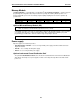
the maximum number of ESI IP phones and Esi-Link channels for each system.
Maximums ESI-1000 ESI-600 ESI-200 ESI-100
IP stations 816 408 192 72
Esi-Link channels 96 48 24 24
3
(Continued)
1
Not supported on the ESI-50 (or ESI-50L).
2
SIP phones are supported on only the IVC 24R.
3
With (E2) IVC 24EL.