
User's Manual



License
Pl
ate Transp
o
nde
r
EV
3
-LPT
OPERATION OF THE TRANSPONDER
1. Remove the baery cap by turning counter-
clockwise;
2. Insert baery to the baery compartment
with posive terminal toward inside;
3. Replace the baery cap and secure it by
turning clockwise;
4. The transponder will beep once when it is
powered up.
5. Now the transponder is ready to be
deployed.
MOUNTING OF THE TRANSPONDER
A matching bracket may be provided for the
transponder.
1. Securely Aach the bracket to a desired
locaon using appropriate methods, such as
magnet, Velcro strips, screws or other
means;
2. Slide the powered transponder into the
bracket unl it is firmly inserted;
3. To remove the transponder from the
bracket, push down the tab at the end of
the bracket, slide the t
ransponder out of
the bracket.
SPECIFICATIONS
RFID Protocol ISO 18000-7:2008
Frequency 433.92MHz
Power A’ Size 3.6V primary
lithium (Li-SOCl2), user
replaceable
Baery Life >6 years at 2 collecons
per day
Range 350 feet unobstructed
Dimensions 6.38 L x 2.17 W x 1.42 H
Weight 4.5 oz (127g)
Operang
Temperature
-30⁰C to +70⁰C
Dust / Moist IP 64
Beeper Audible beeper for tag
locaon and status
indicaon
Memory 256 bytes
Compliance FCC, HERO
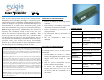
This license plate transponder is one of the more
cost sensitive devices in EV3 family products,
which is designed to provide dramatically
improved functionality at a much more attractive
price point than was attainable by previous con-
ventional Active RFID design approaches. This
device operates in a master/slave con guration
with an interrogator. In all cases, the interrogator
acts as the master unit initiating commands from
the transponder. Once, the device has been suc-
cessfully woken up, it will respond to data trans-
mission from the interrogator by sending packets
of data.
This device complies with part 15 of the FCC Rules and with
RSS-210 of Industry Canada. Operation is subject to the following
two conditions: (1) this device must not cause harmful interfer-
ence, and (2) this device must accept any interference received,
including interference that may cause undesired operation.
NOTE: This equipment has been tested and found to comply with
the limits for a Class A digital device, pursuant to Part 15 of the FCC
Rules. These limits are designed to provide reasonable protection
against harmful interference when the equipment is operated in a
commercial environment. This equipment generates, uses, and can
radiate radio frequency energy and, if not installed and used in
accordance with the instruction manual, may cause harmful
interference to radio communications. Operation of this equip-
ment in a residential area is likely to cause harmful interference in
which case the user will be required to correct the interference at
his own expense.
WARNING: Changes or modi cations not expressively approved by
the party responsible for compliance could void the user's author-
ity to operate the equipment.