
Application Note

2 Fluke Corporation Electronics in your building don’t like power problems
The incoming power was turning
on and off every 10 seconds.
I could hear a clicking noise
and traced it to an uninterrupt
-
ible power supply (UPS) in the
ceiling. The continuous power
problems had damaged the UPS
and caused it to cycle on and off.
If left as-is, the life safety panel
would not function properly
and the new controller would
be damaged. We had to replace
the damaged UPS as well. The
fireman’s panel then functioned
properly.
Power loss/generator
testing
Another problem is power loss.
There can be many causes of a
power loss, including utility prob
-
lems, maintenance lapses, device
surges, and others. Depending
on the condition that caused it,
an electronic device may not
recover properly after the power
is restored.
When a power loss occurs, the
backup generator will start after
a short time delay. I happen to
work in hospitals a lot, and by
code the backup generators have
to start within 10 seconds after
utility power loss. Also by code
the backup generators are tested
Lightning strike
One of the most common sce-
narios is a lightning strike. The
prevalence of this problem will
depend greatly on your location
and climate. I happen to live in
the southeastern United States,
which is famous for summer
thunderstorms in the afternoon.
My personal rule of thumb is
that after a thunderstorm moves
through I will get at least one
or two calls from a building that
are lightning-related. Sometimes
I can even watch weather radar
and know exactly which of my
buildings will be calling me.
Lightning can cause a whole
host of problems. Keep in mind
that a lot of the electronics,
especially HVAC equipment, are
located on the roof or outside
the building. This makes it even
more susceptible to lightning. If
lightning is the culprit, its effects
can be catastrophic. In many
cases the electronics are wiped
out, with visible burn marks and
a burned smell.
Moving the electronics, as
well as better lightning protec-
tion and grounding, can help.
If a computer program is
running on an electronic chip
in the device (EEPROM or Flash
ROM) it may be wiped clean by
the lightning strike and start
up “stupid”—not operate at all. I
have a building with old 1990s
electronics that have to be
reprogrammed after every major
thunderstorm. It is not uncom-
mon, after a power problem, that
1 to 5 percent of the devices on
a building automation system
network do not communicate or
function properly.
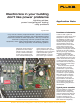
Recently I received a call that
the fireman’s panel in a build-
ing was not functioning. This
building has suffered from many
power problems in the recent
past, usually one every two
weeks or so. The electronic con-
troller in the panel had faulted
out and had to be replaced.
Obviously this was a critical
system. The electronic controller
was replaced and started up. It
worked for a few seconds and
then rebooted every 10 seconds.
once per month. Important build-
ing electronic devices are on this
backup power circuit. Depend-
ing on the causes, there may be
power surges as well as voltage
and current problems as the
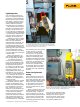
An iFlex
™
flexible current probe is wrapped around the motor leads
at a variable speed drive so the current can be measured with the
Fluke 381 Clamp Meter. This shows whether or not a variable speed
drive has been damaged by a lightning strike.
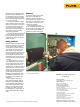
You can check the controller power supply voltage with a Fluke 773
Milliamp Process Clamp Meter. Power problems can affect the power
supply and cause the controller to malfunction or fail.