
Advanced Traffic Management Guide K/KA/KB.15.15

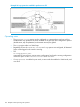

VLANs can overload the switch's CPU. MSTP on the switches covered in this guide complies with
the IEEE 802.1s standard, and extends STP and RSTP functionality to map multiple independent
spanning tree instances onto a physical topology. With MSTP, each spanning tree instance can
include one or more VLANs and applies a separate, per-instance forwarding topology. Thus, where
a port belongs to multiple VLANs, it may be dynamically blocked in one spanning tree instance,
but forwarding in another instance. This achieves load-balancing across the network while keeping
the switch's CPU load at a moderate level (by aggregating multiple VLANs in a single spanning
tree instance). MSTP provides fault tolerance through rapid, automatic reconfiguration if there is
a failure in a network's physical topology.
With MSTP-capable switches, you can create a number of MST regions containing multiple spanning
tree instances. This requires the configuration of a number of MSTP-capable switches. However,
it is not necessary to do this. You can just enable MSTP on an MSTP-capable switch and a spanning
tree instance is created automatically. This instance always exists by default when spanning tree
is enabled, and is the spanning tree instance that communicates with STP and RSTP environments.
The MSTP configuration commands operate exactly like RSTP commands and MSTP is
backward-compatible with the RSTP-enabled and STP-enabled switches in your network.
CAUTION: Spanning tree interprets a switch mesh as a single link. Because the switch
automatically gives faster links a higher priority, the default MSTP parameter settings are usually
adequate for spanning tree operation. Because incorrect MSTP settings can adversely affect network
performance, do not change the MSTP settings from their default values unless you have a strong
understanding of how spanning tree operates.
In a mesh environment, the default MSTP timer settings (Hello Time and Forward Delay) are
usually adequate for MSTP operation. Because a packet crossing a mesh may traverse several
links within the mesh, using smaller-than-default settings for the MSTP Hello Time and Forward
Delay timers can cause unnecessary topology changes and end-node connectivity problems.
MST regions
All MSTP switches in a given region must be configured with the same VLANs, and each MSTP
switch within the same region must have the same VLAN-to-instance assignments. In addition, a
VLAN can belong to only one instance within any region. Within a region:
• All of the VLANs belonging to a given instance compose a single, active spanning tree topology
for that instance.
• Each instance operates independently of other regions.
Between regions there is a single, active spanning tree topology.
How separate instances affect MSTP
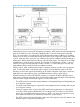
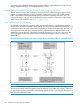
Assigning different groups of VLANs to different instances ensures that those VLAN groups use
independent forwarding paths. For example, in Figure 18 (page 123) each instance has a different
forwarding path.
122 Multiple instance spanning tree operation