
Advanced Traffic Management Guide K/KA/KB.15.15


MSTP VLAN enhancement allows you to preconfigure MSTP topologies before the VLAN IDs
associated with each instance exist on a switch.
• When you use preconfigured VLAN ID-to-MSTI topologies, ensure that MSTP switches remain
in the same region by mapping all VLAN IDs used in the region to the same MSTIs on each
regional switch.
• When you upgrade switch software to release K.13.XX and later, the existing MSTP topology
configuration is automatically saved. All existing VLAN ID-to-MSTI assignments are maintained
on a switch for uninterrupted MSTP network operation.
MSTP compatibility with RSTP or STP
IEEE 802.1s MSTP includes RSTP functionality and is designed to be compatible with both IEEE
802.1D and 802.1w spanning tree protocols. Using the default configuration values, your switches
will interoperate effectively with RSTP and STP devices. MSTP automatically detects when the switch
ports are connected to non-MSTP devices in the spanning tree and communicates with those devices
using 802.1D or 802.1w STP BPDU packets, as appropriate.
To enable effective interoperation with STP (802.1D) configured devices, however, you may need
to adjust the default configuration values. Here are two such examples:
• The rapid state transitions employed by MSTP may result in an increase in the rates of frame
duplication and misordering in the switched LAN. To allow the switch to support applications
and protocols that may be sensitive to frame duplication and misordering, you can disable
rapid transitions by setting the Force Protocol Version parameter to STP-compatible. The value
of this parameter applies to all ports on the switch.
• One of the benefits of MSTP is the implementation of a larger range of port path costs, which
accommodates higher network speeds. However, this can create some incompatibility between
devices running the older 802.1D STP. You can adjust to this incompatibility by implementing
the global spanning tree legacy-path cost command.
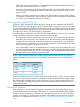
NOTE: RSTP and MSTP implement a greater range of path costs than 802.1D STP, and use
different default path cost values to account for higher network speeds. These values are shown
below.
RSTP and MSTP
path cost
802.1D STP path
cost
Port type
2 000 00010010 Mbps
200 00010100 Mbps
20 00051 Gbps
Because the maximum value for the path cost allowed by 802.1D STP is 65535, devices running
that version of spanning tree cannot be configured to match the values defined by MSTP, at least
for 10 Mbps and 100 Mbps ports. In LANs where there is a mix of devices running 802.1D STP,
RSTP, and MSTPs, you should reconfigure the devices so the path costs match for ports with the
same network speeds.
About BPDU protection
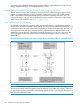
BPDU protection is a security feature designed to protect the active STP topology by preventing
spoofed BPDU packets from entering the STP domain. In a typical implementation, BPDU protection
would be applied to edge ports connected to end user devices that do not run STP. If STP BPDU
packets are received on a protected port, the feature will disable that port and alert the network
manager via an SNMP trap as shown in Example 95 “BPDU protection enabled at the network
edge”.
About MSTP 127