
Advanced Traffic Management Guide K/KA/KB.15.15

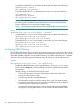
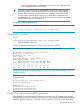
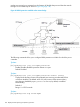
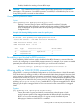
RPVST+ parameters can be configured even if the mode is MSTP and vice versa.
This command does not enable/disable spanning tree. It sets the mode which is
operational once spanning tree is enabled using spanning-tree enable.
The no form of the command changes the spanning tree mode to the default mode
(MSTP)
Configuring global spanning tree
Syntax:
spanning-tree extend system-id
Creates a unique bridge identifier for each VLAN by adding the VLAN ID (vid)
value to the priority field of the bridge identifier in every RPVST+ BPDU.
Syntax
[no]spanning-tree log state-transitions [instance <instance-id> cst]
Command enables/disables event logging for port-block events.
List of VLAN identifiers
Range: <instance-id> 1–16
[vlan <vid-list>]
Syntax:
[no] spanning-tree ignore-pvid-inconsistency
Causes the switch to ignore per-VLAN ID inconsistencies when the ports on both
ends of a point-to-point link are untagged members of different VLANs, thus allowing
RPVST+ to run on the mismatched links. On a given switch, affects all ports belonging
to VLANs on which RPVST+ is enabled.
Default: Disabled
Syntax:
[no] spanning-tree bpdu-protection-timeout timeout
Configures the duration of time when protected ports receiving unauthorized BPDUs
will remain disabled. The default value of 0 (zero) sets an infinite timeout (that is,
ports that are disabled by bpdu-protection are not, by default, re-enabled
automatically).
Default: 0
Range: 0 - 65535 seconds
Configuring per-VLAN spanning tree
Syntax:
spanning-tree vlan <vid-list> hello-time 1...10
Specifies the time in seconds between transmissions of BPDUs on the specified
VLAN(s) when the switch is root for those VLAN(s).
Default: 2
Range: 1 - 10
Syntax:
spanning-tree vlan <vid-list>forward-delay 4...30
Sets the time in seconds the switch waits before transitioning from listening to
learning and from learning to forwarding states.
132 Rapid per-VLAN spanning tree (RPVST+) operation