
Advanced Traffic Management Guide K/KA/KB.15.15
About RPVST+
Comparing spanning tree options
Without spanning tree, having more than one active path between a pair of nodes causes loops
in the network, which can result in duplication of messages, leading to a “broadcast storm” that
can bring down the network.
The 802.1D spanning tree protocol operates without regard to a network's VLAN configuration,
and maintains one common spanning tree throughout a bridged network. This protocol maps one
loop-free, logical topology on a given physical topology. This results in the least optimal link
utilization and longest convergence times.
The 802.1s multiple spanning tree protocol (MSTP) uses multiple spanning tree instances with
separate forwarding topologies. Each instance is composed of one or more VLANs, which
significantly improves network link utilization and the speed of reconvergence after a failure in the
network’s physical topology. However, MSTP requires more configuration overhead and is more
susceptible to dropped traffic due to misconfiguration.
Rapid spanning tree protocol (RSTP) requires less configuration overhead, provides faster
convergence on point-to-point links, and speedier failure recovery with predetermined, alternate
paths. The switches covered by this guide, use the IEEE Rapid Per-VLAN spanning tree Protocol
(RPVST) standard. RPVST was introduced as an enhancement to Rapid spanning tree Protocol
(RSTP) to improve the link utilization issue and require less configuration overhead. Basically,
RPVST+ is RSTP operating per-VLAN in a single layer 2 domain. VLAN tagging is applied to the
ports in a multi-VLAN network to enable blocking of redundant links in one VLAN while allowing
forwarding over the same links for non-redundant use by another VLAN. Each RPVST+ tree can
have a different root switch and therefore can span through different links. Since different VLAN
traffic can take different active paths from multiple possible topologies, overall network utilization
increases.
Another major advantage of RPVST+ is that it localizes topology change propagation to individual
VLANs. Since there is a separate spanning tree for each VLAN, topology changes affecting a
particular VLAN are propagated only inside that VLAN. The switch flushes the MAC addresses
learned only on the affected VLAN and other VLAN traffic is not disturbed. This minimizes the
network flooding caused by the spanning tree topology changes. This is a significant improvement
in the case of a large, flat, layer 2 network. Note that in a network having a large number of
per-VLAN spanning tree instances, RPVST+ can result in an increased load on the switch's CPU.
Understanding how RPVST+ operates
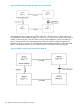
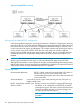
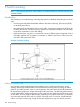
RPVST+ applies one RSTP tree per-VLAN. Each of these RSTP trees can have a different root switch
and span the network through shared or different links. As shown in Figure 22 (page 164)since the
active paths for traffic on different VLANs can use the same for different links, multiple topologies
are possible, and overall network utilization increases.
About RPVST+ 163