
Advanced Traffic Management Guide K/KA/KB.15.15

5 Switch meshing
NOTE: All commands previously in the Summary of commands table are indexed under the entry
Command syntax.
Introduction
Switch meshing is a load-balancing technology that enhances reliability and performance in these
ways:
• Provides significantly better bandwidth utilization than either Spanning Tree Protocol (MSTP)
or standard port trunking.
• Uses redundant links that remain open to carry traffic, removing any single point of failure for
disabling the network, and allowing quick responses to individual link failures. This also helps
to maximize investments in ports and cabling.
• Unlike trunked ports, the ports in a switch mesh can be of different types and speeds (10 and
100 Mbps, gigabit, and 10 gigabit). For example, a 10Base-FL port and a 1GB port can be
included in the same switch mesh.
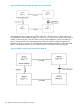
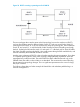
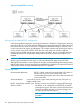
Example 126 Switch meshing
Finding the fastest path
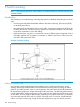
Using multiple switches redundantly linked together to form a meshed switch domain, switch
meshing dynamically distributes traffic across load-balanced switch paths by seeking the fastest
paths for new traffic between nodes. In actual operation, the switch mesh periodically determines
the lowest latency paths, then assigns these paths as the need arises. The path assignment remains
until the related MAC address entry times out. The mesh sees later traffic between the same nodes
as new traffic, and may assign a different path, depending on conditions at the time. For example,
at one time the best path from node A to node B is through switch 2. However, if traffic between
node A and node B ceases long enough for the path assignment to age out, then the next time
168 Switch meshing