
Advanced Traffic Management Guide K/KA/KB.15.15





About switch meshing
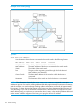
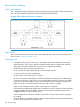
Switch mesh domain
This is a group of meshed switch ports exchanging meshing protocol packets. Paths between these
ports can have multiple redundant links without creating broadcast storms.
Example 138 A switch mesh domain in a network
Edge switch
This is a switch that has some ports in the switch meshing domain and some ports outside of the
domain. (See Example 138 (page 178).)
Operating rules
• A meshed switch can have some ports in the meshed domain and other ports outside the
meshed domain. That is, ports within the meshed domain must be configured for meshing,
while ports outside the meshed domain must not be configured for meshing.
• Meshed links must be point-to-point switch links.
• On any switch, all meshed ports belong to the same mesh domain.
• A switch can have up to 24 meshed ports.
• A mesh domain can include up to 12 switches.
• Up to five inter-switch, meshed hops are allowed in the path connecting two nodes through
a switch mesh domain. A path of six or more meshed hops between two nodes is unusable.
However, in most mesh topologies, there would normally be a shorter path available, and
paths of five hops or fewer through the same mesh will continue to operate.
• Other sources of traffic between meshed switch links are not allowed.
• If the switch has multiple static VLANs and you configure a port for meshing, the port becomes
a tagged member of all such VLANs . If you remove a port from meshing, it becomes an
untagged member of only the default VLAN.
• A port configured as a member of a static trunk (LACP or Trunk) cannot also be configured
for meshing.
• If a port belongs to a dynamic LACP trunk and you impose meshing on the port, it automatically
ceases to be a member of the dynamic trunk.
178 Switch meshing