
Advanced Traffic Management Guide K/KA/KB.15.15
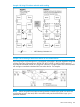

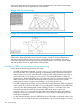
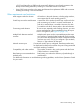

Example 143 Interconnecting switch mesh domains with redundant links
MSTP should be configured on non-mesh devices that use redundant links to interconnect with other
devices or with multiple switch mesh domains. For example:
In the above case of multiple switch meshes linked with redundant trunks, there is the possibility
that spanning tree will temporarily block a mesh link. This is because it is possible for spanning
tree to interpret the cost on an external trunked link to be less than the cost on a meshed link.
However, if this condition occurs, the meshed switch that has a blocked link will automatically
increase the cost on the external (non-meshed) link to the point where spanning tree will block the
external link and unblock the meshed link. This process typically resolves itself in approximately
30 seconds.
Filtering/security in meshed switches
Because paths through the mesh can vary with network conditions, configuring filters on meshed
ports can create traffic problems that are difficult to predict, and is not recommended. However,
configuring filters on non-meshed ports in an edge switch provides you with control and
predictability.
IP Multicast (IGMP) in meshed switches
Like trunked ports, the switch mesh domain appears as a single port to IGMP. However, unlike
trunked ports, IGMP protocol and multicast traffic may be sent out over several links in the mesh
in the same manner as broadcast packets.
Static VLANs
In a network having a switch mesh domain and multiple static VLANs configured, all static VLANs
must be configured on each meshed switch, even if no ports on the switch are assigned to any
VLAN. (The switch mesh is a member of all static VLANs configured on the switches in the mesh.)
When static VLANs are configured, the mesh is seen as a single entity by each VLAN. All ports in
the mesh domain are members of all VLANs and can be used to forward traffic for any VLAN.
However, the non-mesh ports on edge switches that allow traffic to move between the mesh and
non-meshed devices belong to specific VLANs and do not allow packets originating in a specific
VLAN to enter non-meshed devices that do not belong to that same VLAN. (It is necessary to use
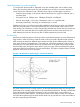
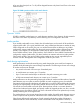
a router to communicate between VLANs.) For example, in Figure 29 (page 185), traffic from host
A entering the switch mesh can only exit the mesh at the port for hosts B and E. Traffic from host
184 Switch meshing