
Advanced Traffic Management Guide K/KA/KB.15.15
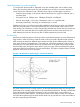
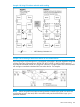

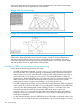

A for any other host (such as C or D) will be dropped because only hosts B and E are in the same
VLAN as host A.
Figure 29 VLAN operation with a switch mesh domain
Dynamic VLANs
If GVRP is enabled, meshed ports in a switch become members of any dynamic VLANs created in
the switch in the same way that they would if meshing was not configured in the switch.
Jumbo packets
If you enable jumbo traffic on any VLAN, then all meshed ports on the switch will be enabled to
support jumbo traffic. (On a given meshed switch, every meshed port becomes a member of every
VLAN configured on the switch.) If a port in a meshed domain does not belong to any VLANs
configured to support jumbo traffic, then the port drops any jumbo packets it receives from other
devices. In this regard, if a mesh domain includes any HP 8212zl switches, 6200yl switches,
Series 5400zl switches, Series 3500yl switches, Series 3400cl or Series 6400cl switches that are
configured to support jumbo traffic, only these switches can transmit and receive jumbo packets.
Other switch models in the mesh will drop jumbo packets as they are not supported by those
switches. See the Management and Configuration Guide for your switch.
Mesh design optimization
Mesh performance can be enhanced by using mesh designs that are as small and compact as
possible while still meeting the network design requirements. The following are limits on the design
of meshes and have not changed:
• Any switch in the mesh can have up to 24 meshed ports.
• A mesh domain can contain up to 12 switches.
• Up to 5 inter-switch meshed hops are allowed in the path connecting two nodes.
• A fully interconnected mesh domain can contain up to 5 switches.
Mesh performance can be optimized by keeping the number of switches and the number of possible
paths between any two nodes as small as possible. As mesh complexity grows, the overhead
associated with dynamically calculating and updating the cost of all of the possible paths between
nodes grows exponentially. Cost discovery packets are sent out by each switch in the mesh every
30 seconds and are flooded to all mesh ports. Return packets include a cost metric based on
inbound and outbound queue depth, port speed, number of dropped packets, etc. Also, as mesh
complexity grows, the number of hops over which a downed link has to be reported may increase,
thereby increasing the reconvergence time.
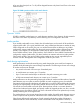
The simplest design is the two-tier design because the number of possible paths between any two
nodes is kept low and any bad link would have to be communicated only to its neighbor switch.
Other factors affecting the performance of mesh networks include the number of destination
addresses that have to be maintained, and the overall traffic levels and patterns. However, a
About switch meshing 185