
Advanced Traffic Management Guide K/KA/KB.15.15
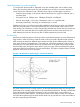
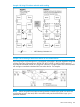

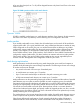
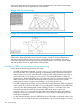
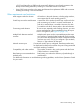
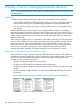
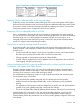
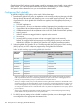

Figure 31 Application of Differentiated Services Codepoint (DSCP) policies
Applying QoS to inbound traffic at the network edge
At the edge switch, QoS classifies certain traffic types and in some cases applies a DSCP policy.
At the next hop (downstream switch) QoS honors the policies established at the edge switch. Further
downstream, another switch may reclassify some traffic by applying new policies, and yet other
downstream switches can be configured to honor the new policies.
Preserving QoS in outbound traffic in a VLAN
QoS is implemented in the form of rules or policies that are configured on the switch. Although
you can use QoS to prioritize traffic only while it moves through the switch, you derive the maximum
benefit by using QoS in an 802.1Q VLAN environment (with 802.1p priority tags) or in an
untagged VLAN environment (with DSCP policies in which QoS sets priorities that downstream
devices can support without reclassifying the traffic).
Using QoS to optimize existing network resources
By prioritizing traffic, QoS supports traffic growth on the network while optimizing the use of
existing resources—and delaying the need for further investments in equipment and services. QoS
enables you to:
• Specify which traffic has higher or lower priority, regardless of current network bandwidth or
the relative priority setting of the traffic when it is received on the switch.
• Change (upgrade or downgrade) the priority of outbound traffic.
• Override "illegal" packet priorities set by upstream devices or applications that use 802.1Q
VLAN tagging with 802.1p priority tags.
Using classifier-based QoS to provide additional policy actions and aid migration
in networks with legacy and OEM devices
Starting in software release K.14.01, HP Switch QoS configuration supports a classifier-based
model that provides added functionality to create and manage QoS policies across a network
consisting of HP switches as well as OEM and legacy devices.
The classifier-based configuration model is a single, simplified procedure and command syntax
for cross-feature usage, which offers:
• Finer granularity than globally-configured QoS for classifying IPv4 and IPv6 traffic
• Additional actions for managing selected traffic, such as rate limiting and IP precedence
marking
• The application of QoS policies to inbound traffic flows on specific port and VLAN interfaces
(instead of using only globally-configured, switch-wide QoS settings)
• The use of configured traffic classes by different software features, such as QoS or port mirroring
Classifier-based QoS is designed to work with existing globally-configured, switch-wide QoS
policies by allowing you to zoom in on a subset of port or VLAN traffic to further manage it.
Classifier-based policies take precedence over and may override globally-configured, switch-wide
QoS settings.
Overview 189