
Advanced Traffic Management Guide K/KA/KB.15.15

Options for assigning priority
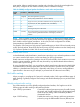
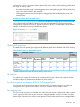
The packet-marking options for global IP-device classifiers include:
• 802.1p priority
• DSCP policy: Assigning a new DSCP and 802.1p priority
For a given IP address or subnet mask, you can assign only one of the above options at a time.
However, for different IP addresses, you can use different options.
Global IP type-of-service classifier
Global QoS classifier precedence: 3
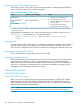
The global IP Type-of-Service classifier enables you to classify and mark IP packets according to
the following modes:
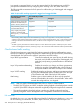
IP-precedence mode All IP packets generated by upstream devices and
applications include a precedence bit set in the ToS/Traffic
Class byte. In IP-precedence mode, the switch uses the
precedence bits to compute and assign the corresponding
802.1p priority.
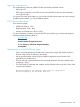
IP Differentiated Services (Diffserv)
Mode
The Diffserv mode uses the codepoints set in IP packets by
upstream devices and applications to assign an 802.1p
priority to packets. You can use Diffserv mode to mark
packets in the following ways:
Assign a new DSCP policy: A policy includes both a
codepoint and a corresponding 802.1p priority. This option
selects an incoming IP packet on the basis of its codepoint
and assigns a new codepoint and corresponding 802.1p
priority. (Use the qos dscp-map command to specify a
priority for any codepoint.
Assign an 802.1p priority: This option reads the DSCP of
an incoming IP packet and, without changing this codepoint,
assigns the 802.1p priority to the packet, as configured in
the DSCP Policy Table. This means that a priority value of
0 - 7 must be configured for a DSCP before the switch can
perform a QoS match on the packet's DSCP bits.
NOTE: Prerequisite: A DSCP codepoint must have a preconfigured 802.1p priority (0 - 7) before
you can use the codepoint to mark matching packets. If a codepoint you want to use shows
No-override in the Priority column of the DSCP Policy table (show qos dscp-map command),
you must first configure a priority for the codepoint before proceeding (qos dscp-map
prioritycommand). Some 802.1p priorities are assigned by default to well-known DSCP
codepoints, such as the "Assured Forwarding" and "Expedited Forwarding" codepoints.
Unless IP-Precedence mode and Diffserv mode are both disabled (the default setting), enabling
one automatically disables the other.
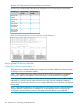
Global Layer-3 protocol classifier
Global QoS Classifier Precedence: 4
When a global Layer-3 Protocol classifier is configured as the highest-precedence classifier and
the switch receives traffic carrying the specified protocol, matching packets are assigned the priority
configured for the classifier.
Global IP type-of-service classifier 249