
Advanced Traffic Management Guide K/KA/KB.15.15
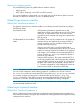

Global VLAN-ID classifier
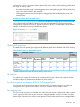
Global QoS Classifier Precedence: 5
The global VLAN-ID (VID) classifier allows you to use up to 4094 VLAN IDs to match packets.
When a particular VLAN-ID classifier has the highest precedence in the switch, traffic received in
the VLAN is marked with the configured priority level. You can configure different global VLAN-ID
classifiers to mark packets with different priority levels.
Options for assigning priority
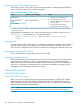
The global QoS packet-marking options for packets that carry a specified VLAN-ID include:
• 802.1p priority
• DSCP policy (Assigning a new DSCP and an associated 802.1p priority; inbound packets
must be IPv4.)
NOTE: A global VLAN-ID classifier marks priority levels only in packets received on static VLANs.
Packets received in a dynamic VLAN created byGVRP operation are not marked by a global
VLAN-ID classifier.
The VLAN ID used as a global QoS classifier must currently exist on the switch. If you remove a
VLAN from the switch, all global QoS configurations that use the VLAN ID for packet marking are
also removed.
Global source-port classifier
Global QoS Classifier Precedence: 6
The global QoS source-port classifier allows you to use a packet's source-port on the switch to
mark packets. When a global source-port classifier has the highest precedence in the switch for
traffic entering through a port, traffic received on the port is marked with the configured priority
level. Different source-port classifiers can have different priority levels.
Options for assigning priority on the switch
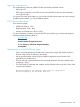
The global QoS packet-marking options for matching packets from a specified source-port include:
• 802.1p priority
• DSCP policy: Assigning a new DSCP and an associated 802.1p priority
Options for assigning priority from a RADIUS server
You can use a RADIUS server to assign a QoS source-port priority during an 802.1X port-access
authentication session. See the RADIUS chapter in the Access Security Guide for your switch.
Radius override field
During a client session authenticated by a RADIUS server, the server can impose a port priority
that applies only to that client session. For more information, see the Access Security Guide for
your switch.
IPv4 ToS/IPv6 traffic class byte
IPv4 packet headers contain a Type of Service (ToS) byte; IPv6 packet headers contain a Traffic
Class byte. In an IPv6 packet, the Traffic Class byte is used in the same way as the ToS byte in an
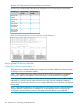
IPv4 packet. A ToS/Traffic Class byte includes a DSCP codepoint and precedence bits:
• Differentiated Services Codepoint (DSCP)
Consists of the upper six bits of the ToS/Traffic Class byte. There are 64 possible codepoints.
250 Quality of Service: Managing bandwidth effectively