
Advanced Traffic Management Guide K/KA/KB.15.15
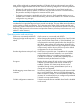
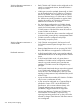
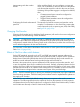
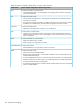
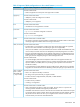
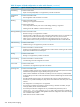

Table 33 Impacts of QinQ configurations on other switch features (continued)
Impacts of QinQ configurations and allowed operationsSwitch feature
In QinQ S-VLAN mode:
• GVRP is supported on S-VLAN ports if the qinq mode is S-VLAN.
In QinQ mixed VLAN mode:
• IGMP-proxy cannot be configured on S-VLANs.
In QinQ S-VLAN mode:
• IGMP-proxy is not supported.
igmp-proxy
In QinQ mixed VLAN mode:
• IPv6 features are not supported on S-VLANs.
IPv6
In QinQ mixed VLAN mode:
• ip-recv-mac cannot be configured on S-VLANs.
In QinQ S-VLANmode:
• ip-recv-mac is not supported.
ip-recv-mac
In QinQ mixed VLAN or S-VLAN modes:
• No change in operations. HP recommends to jumbo-enable all S-VLANs used for customer data
tunneling to support the addition of the extra S-tag in each frame.
Jumbo
In QinQ mixed VLAN mode:LACP/ Port Trunks
• Dynamic-LACP is not supported on S-VLAN ports: LACP manual trunks alone are supported.
The new trunk will be a member of C-VLANs (port types are not applicable).
• If two ports are added to a trunk, the resultant trunk will be a member of the default-vlan (vid-1)
which is always a C-VLAN. The trunk can subsequently be manually assigned to an S-VLAN.
• Port-type and VLAN configurations are not mapped. If the port-type is updated through CLI or
SNMP and the port is subsequently moved from the C-VLAN space to the S-VLAN space then
back again, the last configured port-type is retained through each move.
In QinQ S-VLAN mode:
• On S-VLAN bridges, both manual and dynamic LACP trunks are supported. HP does not
recommend that you configure dynamic trunks on customer ports because they cannot become
dynamic members of S-VLANs (there is no provider-gvrp for a dynamic trunk to become a
member of S-VLANs.)
• A newly formed trunk will by default be of type provider-network. When the trunk is manually
assigned to an S-VLAN for the first time after being created, the port-type is provider-network.
In QinQ mixed VLAN mode:Layer 3 Protocols
(IP, IP+, DHCP,
• There is no IP layer functionality on S-VLANs.
ARP, IGMP Layer
3, Layer 3 ACLs)
• No change in IP layer functionality on regular C-VLANs.
• S-VLANs cannot be configured as RIP, OSPF, PIM, or VRRP interfaces.
In QinQ S-VLAN mode:
• S-VLANs can be ip enabled.
• IP routing is not supported.
In QinQ mixed VLAN or S-VLAN modes:LLDP
• LLDP is supported on the device (in both qinq modes). However, there is no provision for
tunneling customer LLDP BPDUs through the provider-network.
• LLDP BPDUs received from a customer's network will be consumed at the customer-network ports
of a provider device and the customer device will be displayed as an LLDP neighbor. Similarly
the provider network device will show up as a neighbor on the customer's network if the
customer-network ports send out LLDP advertisements.
About QinQ 339