
Advanced Traffic Management Guide K/KA/KB.15.15
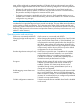
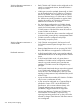
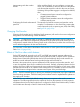
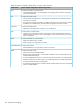
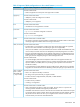
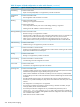

Table 33 Impacts of QinQ configurations on other switch features (continued)
Impacts of QinQ configurations and allowed operationsSwitch feature
In QinQ S-VLAN mode:
• Equal cost multi-path (ECMP) is not supported on provider core devices.
load-sharing
In QinQ mixed VLAN mode:
• The management VLAN cannot be an S-VLAN.
management
VLAN
In QinQ mixed VLAN mode:
• Meshing is not supported on the device.
In QinQ S-VLAN mode:
Meshing
• On an all provider-network ports of an S-VLAN bridge, meshing is supported.
• Meshing cannot be enabled on customer-network ports.
In QinQ mixed VLAN mode:Mirroring/Monitoring
• Remote mirroring is not supported on S-VLANs.
• Cannot monitor a VLAN with mirror ports in the other VLAN domain. That is, an S-VLAN or an
S-VLAN port cannot be monitored using a C-VLAN port as its mirror, and vice-versa.
• When a port is moved from the S-VLAN space to the C-VLAN space (or vice versa), all
mirror/monitor sessions on the port must be unconfigured before the move will be allowed.
In QinQ S-VLAN mode:
• Multicast routing is not supported on provider core devices.
multicast-routing
In QinQ mixed VLAN or S-VLAN modes:
• HP does not recommend that you enable DSCP on S-VLANs used for tunneling as the customer
IP-pkt will be modified in the S-VLAN space.
QoS
In QinQ S-VLAN mode:
• Routing is not supported on provider core devices.
Routing
In QinQ mixed VLAN or S-VLAN modes:
• source-binding cannot be configured on S-VLANs.
source-binding
In QinQ S-VLAN mode:
• source-route is not supported on provider core devices.
source-route
In QinQ mixed VLAN mode:Spanning Tree
• Customer (C-VLAN) spanning tree is supported. All C-VLAN ports will receive/transmit customer
STP BPDUs and participate in regular VLAN spanning tree as usual.
• When customer STP BPDUs are received at S-VLAN ports on the switch, they will be flooded
out of the other ports on the S-VLAN. All such frames will be tunneled through the S-VLAN tunnel
unscathed.
• Provider (S-VLAN) spanning tree is not supported on the switch. If S-VLAN STP frames are
received on any S-VLAN enabled ports, they will be re-forwarded out of the other ports on the
S-VLAN.
• STP configuration on S-VLAN ports is not supported.
• If a port that is a member of C-VLANs is moved into being a member of S-VLANs, the port
would, by default, tunnel customer STP BPDUs.
• If a C-VLAN port has been configured with any non-default STP parameters (such as
admin-edge, auto-edge, and bpdu-protect) and is then moved into an S-VLAN, the
port will be put into a forwarding state regardless of the STP configurations done when the port
was a member of the C-VLAN.
• MSTP instances cannot include S-VLANs.
340 QinQ (Provider bridging)