
Advanced Traffic Management Guide K/KA/KB.15.15
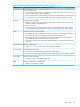
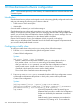
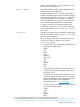
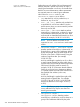
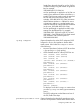

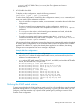
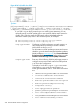
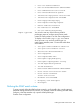

Table 33 Impacts of QinQ configurations on other switch features (continued)
Impacts of QinQ configurations and allowed operationsSwitch feature
In QinQ S-VLAN mode:
• Provider (S-VLAN) spanning tree is supported—both provider-network ports and customer-network
ports will receive/transmit provider STP BPDUs.
• Customer (VLAN) spanning tree tunneling is supported on S-VLAN interfaces—customer-network
or provider-network ports will tunnel customer STP BPDUs through the appropriate S-VLAN.
In QinQ mixed VLAN mode:
• Stacking is supported only on C-VLANs. The device does not advertise itself (using the stack
discovery protocol) in the S-VLAN space.
In QinQ S-VLAN mode:
• Stacking discovery protocol frames will not be sent out of customer-network ports; similarly,
any stacking discovery protocol frames received on customer-network ports will be dropped.
Stacking
In QinQ mixed vlan or S-VLAN modes:UDLD
• UDLD frames received on udld-disabled customer network ports will be dropped. However, if
the customer-network port is udld-enabled, it can peer with a customer device.
• UDLD frames received on udld-disabled provider network ports will be re-forwarded out of
other udld-disabled provider network ports on the same VLAN.
• UDLD re-forwarding in the C-VLAN space (QinQ disabled or mixed VLAN mode) will remain
unaltered.
In QinQ S-VLAN mode:
• udp-bcast-forward is not supported on provider core devices.
udp-bcast-forward
In QinQ mixed VLAN mode:unknown-vlans
• GVRP (learn and disabled modes) not supported on S-VLAN ports.
• A C-VLAN port that has GVRP enabled will need to disable it before it can be added to S-VLANs.
In QinQ mixed VLAN mode:
• S-VLANs cannot be configured as voice-VLANs.
Voice VLANs
In QinQ mixed VLAN or S-VLAN modes:
• VRRP is not supported on S-VLANs.
VRRP
About QinQ 341