
Advanced Traffic Management Guide K/KA/KB.15.15



Syntax:
policy resequence name seq-number interval
resequence Resets the sequence numbers for all class-action statements in the
policy.
name Specifies the name of the policy that contains the class-action
statements that you want to resequence.
seq-number Specifies the sequence number of the first class-action-statement
in the policy. Default: 10.
interval Specifies the interval between sequence numbers of class-action
statements in the policy to allow additional statements to be
inserted. Default: 10.
NOTE: When resequencing class-action statements in a policy, the default class-action-statement
always remains as the last class-action statement.
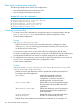
To view the current class-action numbering in a policy, enter the following command:
show policy feature-name policy-name
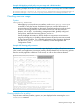
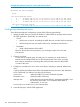
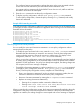
Example 223 Resequencing a policy configuration
The following example shows how to resequence a policy configuration after Viewing its contents.
The resequenced policy allows you to add a new class-action statement between entries 100 and
200.
Applying a service policy to an interface
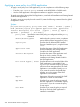
To apply feature-specific service policies to inbound port or VLAN interfaces, use the interface
service-policy in or vlan service-policy in command.
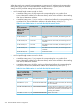
The following service-policy restrictions apply to all software features:
• A service policy is supported only on inbound traffic.
• Only one feature-specific policy (for example, QoS or mirroring) is supported on a port or
VLAN interface.
• PBR is only supported within a vlan [vlan-id] service-policy [policy-name]
in command or within a VLAN context. PBR is not applicable a port‐specific interface.
Applying a service policy to an interface 361