
Advanced Traffic Management Guide K/KA/KB.15.15

NOTE: Although IPv4 and IPv6 masks are applied in opposite directions:
◦ An IPv4 mask-length is applied from right to left, starting from the rightmost bits.
◦ An IPv6 prefix-length is applied from left to right, starting from the leftmost bits.
The behavior of IPv4 and IPv6 masks as match criteria and wildcards is the same.
Where to go from here
Classifier-based service policies are designed to work with your existing globally-configured
software settings. While existing software features allow you to globally manage all network traffic
on a switch or port, classifier-based service policies allow you to zoom in on subsets of network
traffic to further manage it on a per-port or per-VLAN basis.
You can use the match criteria described in this chapter across software features to configure
classes of traffic for use in feature-specific service policies.
After you decide on the IPv4 and IPv6 network traffic you want to manage, see the Management
and Configuration Guide for more information about how to configure and use classifier-based
quality-of-service and mirroring policies.
Traffic class-based configuration model
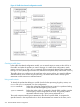
Traffic class-based software configuration consists of the following general steps:
1. Determine the inbound traffic you want to manage and how you want to manage it. For
example, you may want to rate limit certain traffic, prioritize it, mirror it, and so on.
2. Classify the traffic that you want to manage by configuring a class, using match and ignore
commands. A traffic class is configured separately from service policies and can be used in
various policies.
3. Configure a service policy for one or more address classes, including an optional, default
class. A policy consists of configuration commands executed on specified traffic classes for
one of the following software features:
• Quality of Service (policy qos command)
• Port and VLAN mirroring (policy mirror command)
• Policy Based Routing (policy pbr command)
4. Assign the policy to an inbound port or VLAN interface using the interface
service-policy in or vlan service-policy in command.
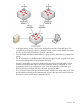
The following figure shows an overview of traffic class-based software configuration.
About Classifier-based configuration 371