
Advanced Traffic Management Guide K/KA/KB.15.15

match is found. Be sure to enter match/ignore statements in the precise order in which you want
their criteria to be used to check packets.
• As soon as a field in a packet header matches the criteria in a match statement, the sequential
comparison of match criteria in the class stops, and the policy actions configured for the class
are executed on the packet.
• If a packet matches the criteria in an ignore statement, the sequential comparison of match
criteria in the class stops, and no policy action is performed on the packet.
If a packet does not match the criteria in any match/ignore statement in a traffic class configuration,
one of the following actions is taken:
• The packet is transmitted without a policy action performed on it.
• If a default class is configured in the policy, the actions specified in the default-class
command are performed on packets that do not match the criteria in preceding classes in the
policy.
The following match criteria are supported in match/ignore statements for inbound IPv4/IPv6
traffic:
• IP source address (IPv4 and IPv6)
• IP destination address (IPv4 and IPv6)
• Layer 2 802.1Q VLAN ID
• Layer 3 IP protocol
• Layer 3 IP precedence bits
• Layer 3 DSCP bits
• Layer 4 TCP/UDP application port (including TCP flags)
• VLAN ID
Using zone classes
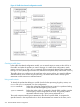
Zone classes are used in conjunction with a technology called Transparent Mode. Both zone classes
and Transparent Mode are supported on the HP 5400zl and 8200zl Switch Series when:
• The switch is running software version K.14.58 and above
• An HP AllianceONE Extended Services zl Module is installed in the switch
Transparent Mode enables the HP 5400zl or 8200zl switch to intercept packets that match certain
criteria and redirect them to an application that is running on an HP AllianceONE Extended Services
zl Module. In effect, Transparent Mode allows that application to be in the path of packet flow.
(Applications that run on AllianceONE Extended Services zl Modules are referred to as ONE
applications.)
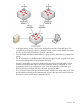
Packet interception differs from port mirroring. With port mirroring, the switch copies the packets
being sent from a particular source port to a particular destination port and sends these packets
to a mirror port. The original packets continue to be sent from the source port to the destination
port without interruption.
With packet interception, on the other hand, the switch does not copy packets to another port.
Instead the switch actually intercepts the packets and forwards them to the ONE application. The
ONE application can then make decisions based upon those packets and control or modify the
packets before they are delivered to their final destination.
After intercepting and redirecting the packets to the ONE application, the HP 5400zl or 8200zl
switch does not perform any further action on the intercepted packets.
Because a ONE application is required to act on the intercepted packets, Transparent Mode is
available only when an HP AllianceONE Extended Services zl Module is installed in the zl switch.
In addition, the switch must also be running software version K.14.58 or above.)
About Classifier-based configuration 373