
IPv6 Configuration Guide K/KA/KB.15.15
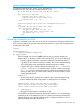
These are the same as those used with the TCP/UDP source-port options and are
listed earlier in this command description.
Comparison operators and well-known port names
[ established ]
This option applies only where TCP is the configured IPv6 protocol type. It blocks
the synchronizing packet associated with establishing a new TCP connection,
while allowing all other IPv6 traffic for existing connections.
For example, a Telnet connect requires TCP traffic to move both ways between
a host and the target device. Simply applying a deny to inbound Telnet traffic
on a VLAN prevents Telnet sessions in either direction, because responses to
outbound requests are blocked. However, by using the established option,
inbound Telnet traffic arriving in response to outbound Telnet requests are
permitted, but inbound Telnet traffic trying to establish a new connection is
denied.
The established and dscp options are mutually exclusive in a given ACE.
Configuring established and any combination of TCP control bits in the
same ACE is supported, but established must precede any TCP control bits
configured in the ACE.
TCP control bits
In a given ACE for filtering TCP traffic you can configure one or more of these
options:
[ ack ]
Acknowledgment
[ fin ]
Sender finished
[ rst ]
Connection reset
[ syn ]
TCP control bit: sequence number synchronize
For more information on using TCP control bits, see RFC 793.
Filtering ICMP traffic
This option allows configuring an ACE to selectively permit some types of ICMP traffic, while
denying other types. An ACE designed to permit or deny ICMP traffic can optionally include an
ICMP type and code value to permit or deny an individual type of ICMP packet, while not addressing
other ICMP traffic types in the same ACE. As a further option, the ACE can include the name of
an ICMP packet type.
Syntax:
[ deny | permit ] icmp SA DA icmp-type icmp-code
[ deny | permit ] icmp SA DA icmp-type-name
Using icmp as the packet protocol type, you can optionally specify an individual
ICMP packet type or packet type/code pair to further define the criteria for a match.
This option, if used, is entered immediately after the destination IP address (DA)
entry.
Configuration Commands 121