
IPv6 Configuration Guide K/KA/KB.15.15

IPv6 routing operation
A switch moves packets within the same local network or subnet. A router moves packets between
networks or subnets. When a router receives a packet, it matches the packet's destination address
to a route in its routing table. This route specifies the gateway, or next-hop, through which the
router must forward the packet to enable it to move toward its destination. The gateway is specified
as either the next-hop link-local address on a shared VLAN, the ID of that VLAN (vid), or a global
unicast address.
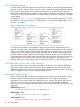
For example, in Figure 13 (page 174) the gateway for a packet moving through router "D" to the
2001:db8:0:9::/64 network (router "A") is either VLAN 3 or the link-local address FE80::3:2/64
in VLAN 3 on router "C."
Figure 13 Example of a routing domain
A routing switch maintains a routing table containing the best routes to the destinations it has
acquired. The routing table can be built from statically configured routes and dynamically configured
OSPFv3 routes. Static routes must be manually configured and are best suited for small networks
having few routes and where topology changes are infrequent. A dynamic routing protocol such
as OSPFv3 offers scalable control for discovering and assessing reliable routes. The best route to
a given destination may change over time, and dynamic routing protocols can react to such changes
by replacing routes in the routing table. Dynamic routing also adapts to changes in network
topology, while static routing requires manual configuration changes to support topology changes.
Concurrent static and dynamic routing operation
Static and dynamic routing can operate concurrently in a network. Where there are both static
and dynamic routes to the same destination, the routing switch selects the route with the lowest
administrative distance for inclusion in the routing table. If the selected route goes down, the routing
switch can replace it with a previously existing alternative route.
Router Advertisements (RAs)
RAs are used in both static and dynamic routing environments and are transmitted per-IP routing
interface from the routing switch for host configuration. RAs carry configuration settings for
parameters, such as network prefix and neighbor discovery, and are also used to direct hosts to
DHCPv6 servers for configuration settings. Enabling IPv6 routing automatically enables RA
transmission on all IP routing interface where it has not been suppressed with one of the following
commands:
Global Config Context:
HP Switch(config)# ipv6 nd suppress-ra
VLAN Config Context:
HP Switch(vlan-1)# ipv6 nd ra suppress
Tunnel Config Context:
HP Switch(tunnel-3)# ipv6 nd ra suppress
174 IPv6 Routing Basics