
IPv6 Configuration Guide K/KA/KB.15.15
General configuration steps for OSPFv3
To begin using OSPFv3 on the routing switch:
1. Enable IPv6 on at least one VLAN interface.
2. In the global config context, use ipv6 unicast-routing to enable routing
3. Execute router ospf3 enable to enable OSPFv3 routing.
4. Use area in the ospf3 context to assign the areas to which the routing switch will be attached.
5. Assign VLAN interfaces to the configured areas by moving to each VLAN context and using
the command ipv6 ospf3 area ospf-area-id assigns all interfaces in the VLAN to the
same area.
6. Optional: Assign loopback interfaces to OSPFv3 areas by using the interface loopback
0 - 7 ipv6 ospf3 area command.
7. Optional: On each routing switch used as an ASBR in your OSPFv3 domain:
a. Configure route-maps to permit route prefixes you want redistributed in your OSPFv3
domain and to deny all others.
b. Configure redistribution to enable importing the static and connected routes you want to
make available in the domain.
8. Optional: Configure ranges on ABRs to reduce inter-area RA.
9. Optional: Use administrative distance to influence route choices.
10. Optional: Enforce strict LSA operation for graceful restart helper mode.
11. Optional: Adjust performance by changing the IP routing interface settings, if needed. Includes
cost, dead-interval, hello-interval, and priority commands.
12. Configure virtual links for any areas not directly connected to the backbone.
Configuration rules
• If the switch is to operate as an ASBR, you must enable redistribution; see “General
configuration steps for OSPFv3” (page 257). When you do so, ASBR capability is automatically
enabled. For this reason, you should first configure route policy and redistribution filters on
the ASBR. Otherwise, all possible external routes will be allowed to flood the domain (see
page 258).
• Each IP routing interface on which you want OSPFv3 to run must be assigned to one of the
defined areas. When a VLAN interface is assigned to an area, the IPv6 addresses configured
on that VLAN are automatically included in the assignment.
OSPFv3 global and interface settings
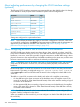
When first enabling OSPF, you may want to consider configuring ranges and restricting redistribution
(if an ASBR is used) to avoid unwanted advertisements of external routes. You may also want to
enable OSPFv3 traps to enhance troubleshooting. However, it is generally recommended that the
remaining parameters with non-null default settings be left as-is until you have the opportunity to
assess OSPFv3 operation and determine whether any adjustments to default settings is warranted.
For information on when to use the global and per-interface commands used with OSPFv3, see
“Configuring OSPFv3 on the routing switch” (page 209). For detailed information on each command,
see the page listed for each command.
OSPFv3 global and interface settings 257