
IPv6 Configuration Guide K/KA/KB.15.15

About adjusting performance by changing the VLAN interface settings
(optional)
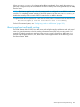
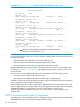
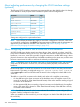
The following OSPFv3 interface parameters are automatically set to their default values. No change
to the defaults is usually required unless needed for specific network configurations.
PageDefaultParameter
2211cost
22140 secondsdead-interval
22210 secondshello-interval
2221priority
2225 secondsretransmit-interval
2221 secondtransit-delay
226disabledpassive
Settings are configured on a per-interface basis.
NOTE: Most of these parameters also apply to virtual link configurations. However, when used
on a virtual link configuration, the OSPFv3 context requirement is different and the parameters are
applied only to the interfaces included in the virtual link. See “About adjusting virtual link
performance by changing the interface settings” (page 261).
About configuring an ABR to use a virtual link to the backbone
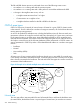
All OSPFv3 ABRs (area border routers) must have either a direct, physical or indirect, virtual link
to the OSPFv3 backbone area (0.0.0.0 or 0). If an ABR does not have a physical link to the area
backbone, it can use a virtual link to provide a logical connection to another ABR having a direct
physical connection to the area backbone. Both ABRs must belong to the same area, and this area
becomes a transit area for traffic to and from the indirectly connected ABR.
NOTE: A backbone area can be purely virtual with no physical backbone links. Also note that
virtual links can be linked in a series. If so, one end may not be physically connected to the
backbone.
Because both ABRs in a virtual link connection are in the same OSPFv3 area, they use the same
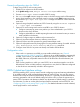
transit area ID. This setting is configured using area area-id virtual-link router-id
in the router ospf3 context and should match the area ID value configured on both ABRs in the
virtual link.
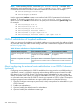
The ABRs in a virtual link connection also identify each other with a neighbor router setting:
• On the ABR having the direct connection to the backbone area, the neighbor router is the
router ID (in decimal or 32-bit dotted decimal format) of the router interface needing a logical
connection to the backbone.
• On the opposite ABR (the one needing a logical connection to the backbone), the neighbor
router is the router ID (in decimal or 32-bit dotted decimal format) of the ABR that is directly
connected to the backbone.
NOTE: By default, the router ID is the lowest numbered IPv4 address or (user-configured) IPv4
loopback interface configured on the device.
When you establish an area virtual link, you must configure it on both of the ABRs (both ends of
the virtual link).
260 OSPFv3 Routing