
IPv6 Configuration Guide K/KA/KB.15.15

11 IPv6 Tunneling Over IPv4 Using Manually Configured
Tunnels
NOTE: All commands previously in the Summary of commands table are indexed under the entry
Command syntax.
Overview
IPv6 over IPv4 tunneling is a way to establish point-to-point tunnels by encapsulating IPv6 packets
within IPv4 headers so that they can be carried over the IPv4 routing infrastructure. IPv6 over IPv4
tunneling provides a mechanism for utilizing the existing IPv4 routing infrastructure to carry IPv6
traffic between IPv6 networks.
There are a number of IPv6 tunneling mechanisms. Currently only tunneling IPv6 traffic over an
IPv4 network through 6in4 manually configured tunnel endpoints is supported.
Tunnels are an additional routing interface type, similar to a VLAN interface or a loopback interface.
Routing into 6in4 tunnels is supported for:
• A standard route table lookup
• Static Routes
• Policy Based Routing (PBR)
• Running OFPFv3 over the point-to-point tunnel interface
See RFC 4213 Basic Transition Mechanisms for IPv6 Hosts and Routers for more information about
tunneling.
Tunneling can be used for:
• Router to router—IPv4 routers connected by an IPv4 infrastructure can tunnel IPv6 packets
among themselves. The tunnel spans one segment of the end-to-end path.
• Host to router—IPv4 and IPv6 hosts can tunnel IPv6 packets to an intermediary IPv6 or IPv4
router that is reachable through an IPv4 infrastructure. The tunnel spans the first segment of
the end-to-end path.
• Host to host—IPv6 or IPv4 hosts that are interconnected by an IPv4 infrastructure can tunnel
IPv6 packets among themselves. The tunnel spans the entire end-to-end path.
• Route to host— IPv6 or IPv4 routers can tunnel IPv6 packets to their final destination IPv6 or
IPv4 host. This tunnel spans only the last segment of the end-to-end path.
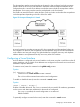
Configured tunnels are usually used in the router-to-router configuration because the tunnel endpoints
need to be explicitly configured.
The tunnel endpoint includes:
• The entry node of the tunnel (the encapsulator), which creates an encapsulating IPv4 header
and sends the encapsulated packet. Which packets to tunnel is determined by a routing table
lookup based on the IPv6 address.
• The exit node of the tunnel (the decapsulator):
receives the encapsulated packet◦
◦ reassembles the packet if needed
◦ removes the IPv4 encapsulating header
◦ processes the IPv6 packet in the usual manner
262 IPv6 Tunneling Over IPv4 Using Manually Configured Tunnels