
IPv6 Configuration Guide K/KA/KB.15.15

About disabling IPv6 on a VLAN
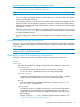
While one IPv6-enabling command is configured on a VLAN, IPv6 remains enabled on that VLAN.
In this case, removing the only IPv6-enabling command from the configuration disables IPv6
operation on the VLAN. That is, to disable IPv6 on a VLAN, the following commands must be
removed from the VLAN's configuration:
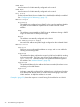
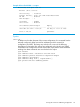
ipv6 enable
ipv6 address dhcp full rapid-commit
ipv6 address autoconfig
ipv6 address fe80::interface-id link-local
ipv6 address prefix:interface-id
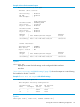
If any of the above remain enabled, IPv6 remains enabled on the VLAN and, at a minimum, a
link-local unicast address is present.
Neighbor discovery
Neighbor Discovery (ND) is the IPv6 equivalent of the IPv4 ARP for layer 2 address resolution. ND
uses IPv6 ICMP messages to provide for discovery of IPv6 devices such as other switches, routers,
management stations, and servers on the same interface. ND runs automatically in the default
configuration and provides services in addition to those provided in IPv4 by ARP. For example:
• Determine the link-layer address of neighbors on the same VLAN or tunnel interface.
• Verify that a neighbor is reachable. Track neighbor (local) routers.
• Track neighbor (local) routers.
Neighbor Discovery enables functions such as the following:
• router and neighbor solicitation and discovery
• detecting address changes for devices on a VLAN or tunnel
• identifying a replacement for a router or router path that has become unavailable
• duplicate address detection (DAD)
• router advertisement processing
• neighbor reachability
• autoconfiguration of unicast addresses
• resolution of destination addresses
• changes to link-layer addresses
An instance of ND is triggered on a device when a new (tentative) or changed IPv6 address is
detected. (This includes stateless, stateful, and static address configuration.) ND operates in a
per-VLAN scope, that is, within the VLAN on which the device running the ND instance is a member.
ND actually occurs when there is communication between devices on a VLAN. That is, a device
needing to determine the link-layer address of another device on the VLAN initiates a (multicast)
neighbor solicitation message (containing a solicited-node multicast address that corresponds to
the IPv6 address of the destination device) on the VLAN. When the destination device receives the
neighbor solicitation, it responds with a neighbor advertisement message identifying its link-layer
address. When the initiating device receives this advertisement, the two devices are ready to
exchange traffic on the VLAN interface. Also, when an IPv6 interface becomes operational, it
transmits a router solicitation on the interface and listens for an RA.
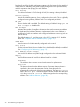
NOTE: Neighbor and router solicitations must originate on the same VLAN as the receiving
device. To support this operation, IPv6 is designed to discard any incoming neighbor or router
solicitation that does not have a value of 255 in the IP Hop Limit field. For a complete list of
requirements, see RFC 246.
30 IPv6 Addressing Configuration